

Artificial Intelligence (AI) is rapidly transforming the modern workplace by automating tasks, improving efficiency, reducing costs, and increasing productivity. From healthcare and education to manufacturing and business management, technologies such as machine learning, robotics, and generative AI are changing how people work.
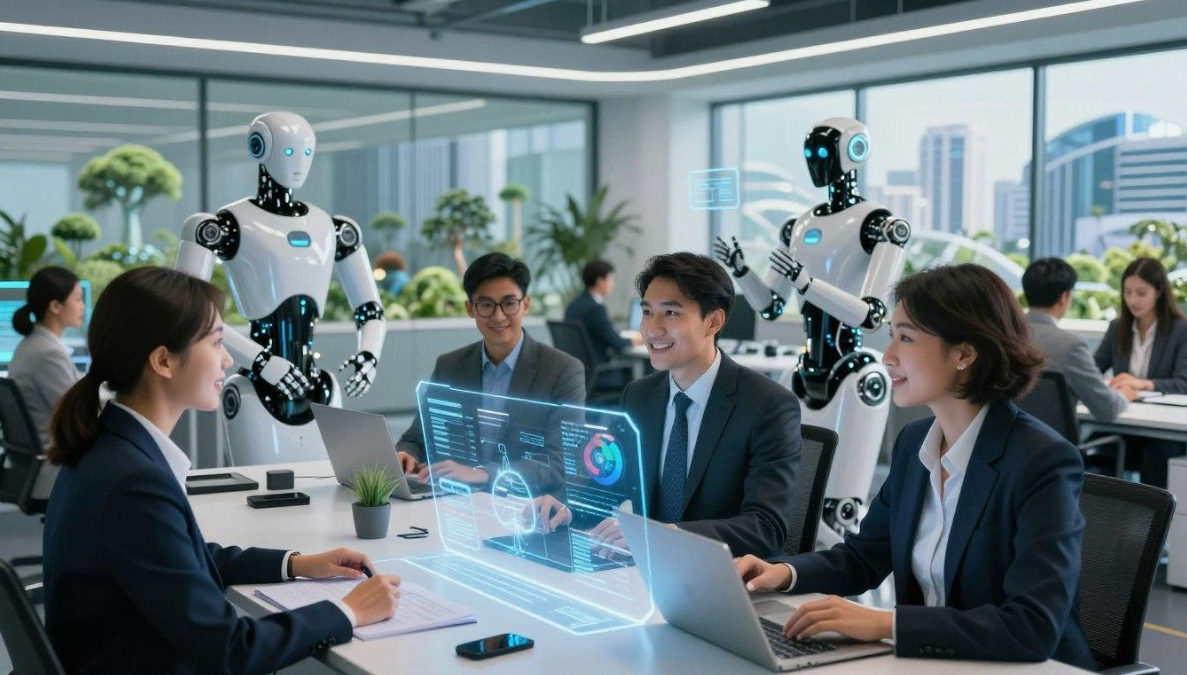
While AI may replace certain jobs and create challenges such as unemployment, it also offers new career opportunities, transforms existing roles, and creates entirely new professions. Thus, AI is reshaping the future of work by bringing both challenges and opportunities to the workforce.
1. How AI Is Transforming the Workplace
AI has become an important part of many industries. Businesses are increasingly adopting AI-powered tools to automate repetitive tasks, analyze large amounts of data, and make better decisions.
For example:
-
Healthcare: AI helps doctors analyze medical images, identify diseases, and support treatment decisions.
-
Education: AI-powered learning platforms provide personalized learning experiences for students.
-
Banking: AI detects fraudulent transactions and improves financial security.
-
Manufacturing: Robots and intelligent machines perform repetitive tasks with greater speed and precision.
-
Customer Service: AI chatbots answer customer questions and provide support around the clock.
-
Information Technology: AI assists developers with coding, software testing, and debugging.
These developments demonstrate that AI is not just a technological trend; it is becoming a major force shaping the future of employment.
2. Will AI Replace Human Employees?
One of the biggest concerns surrounding AI is job displacement. As machines become more intelligent and capable, several tasks traditionally performed by humans can now be automated.
Jobs involving repetitive, predictable, and rule-based activities are particularly vulnerable. For instance, data entry operators, basic customer support representatives, assembly-line workers, and certain administrative employees may face increased automation.
AI can perform many tasks faster, work continuously without breaks, and process enormous amounts of information. This makes it attractive for companies looking to improve efficiency and reduce operational costs.
However, it is important to understand that AI is more likely to replace specific tasks than eliminate every job entirely.
Many professions require human judgment, creativity, emotional intelligence, communication, and decision-making. These qualities remain essential in areas such as healthcare, teaching, leadership, counseling, and creative industries.
Therefore, instead of completely replacing humans, AI will often change the responsibilities and skills required in different professions.
3. New Career Opportunities Created by AI
Although AI may eliminate certain traditional roles, it is also creating new employment opportunities. As organizations adopt advanced technologies, they need skilled professionals who can develop, manage, maintain, and improve AI systems.
Some emerging career opportunities include:
1. AI and Machine Learning Engineers: These professionals design and develop intelligent systems that can learn from data and perform complex tasks.
2. Data Scientists: They analyze large datasets to identify patterns, generate insights, and help organizations make informed decisions.
3. AI Ethics Specialists: They ensure that AI systems are developed and used responsibly, fairly, and transparently.
4. Robotics Engineers: They design, build, and maintain robots used in industries such as healthcare, manufacturing, and logistics.
5. Cybersecurity Experts: As digital technologies expand, organizations need professionals to protect systems, networks, and sensitive information from cyber threats.
6. Prompt Engineers and AI Specialists: They help organizations use generative AI tools effectively by designing instructions and improving AI-generated outputs.
7. AI Trainers and Auditors: They help improve AI systems by evaluating their performance, identifying errors, and ensuring the quality of their outputs.
These careers highlight how technological progress can create new possibilities for individuals who are willing to learn and adapt.
4. The Importance of Human Skills in the AI Era
Even as AI becomes more advanced, human skills will continue to play an important role in the workplace. Machines can process information and generate content, but they do not fully replace human understanding, emotions, values, and social intelligence.
Some of the most valuable skills for the future include:
-
Critical Thinking: The ability to evaluate information and make logical decisions.
-
Creativity: Developing original ideas and finding innovative solutions.
-
Communication: Expressing ideas clearly and working effectively with others.
-
Emotional Intelligence: Understanding emotions, building relationships, and showing empathy.
-
Problem-Solving: Handling complex situations that require human judgment.
-
Adaptability: Learning new technologies and adjusting to changing work environments.
Employees who combine technical knowledge with strong human skills will be better prepared to succeed in an AI-driven workplace.
5. Challenges of the AI Workforce Revolution
Despite its advantages, the AI revolution also brings several challenges that cannot be ignored.
Job Displacement: Workers in highly automated industries may lose their jobs if they cannot transition into new roles.
Skill Gaps: Many employees may lack the technical knowledge required to work alongside AI systems.
Economic Inequality: The benefits of AI may be concentrated among large companies and highly skilled workers, increasing the gap between different income groups.
Data Privacy and Security: The use of AI involves processing large amounts of personal and organizational data, creating concerns about privacy and cybersecurity.
Overdependence on Technology: Excessive reliance on AI may reduce human involvement in important decisions and create risks when systems produce incorrect results.
To address these challenges, governments, educational institutions, and businesses must work together to ensure that technological progress benefits society as a whole.
6. How Employees Can Prepare for the Future
The future of work will belong to people who are willing to continuously learn and develop new skills. Employees should not view AI only as a threat but also as a tool that can improve their productivity and career prospects.
Here are some important steps individuals can take:
-
Learn AI Tools: Become familiar with popular AI platforms and understand how they can support professional tasks.
-
Develop Digital Skills: Improve knowledge of computers, data analysis, programming, and digital communication.
-
Focus on Continuous Learning: Participate in online courses, workshops, certifications, and professional training programs.
-
Strengthen Human Skills: Develop creativity, leadership, teamwork, communication, and critical thinking.
-
Embrace Change: Be open to new responsibilities, technologies, and career opportunities.
-
Combine AI with Expertise: Learn how to use AI tools within your chosen profession to become more efficient and valuable.
The key to success is not competing against AI but learning how to work effectively with it.
7. The Future: Humans and AI Working Together
The future workplace is likely to be based on collaboration between humans and intelligent machines. AI can handle repetitive tasks, analyze information, and provide recommendations, while humans can focus on strategic thinking, creativity, leadership, and decision-making.
For example, a doctor can use AI to analyze medical reports but still relies on professional experience and human understanding to treat patients. Similarly, a teacher can use AI to prepare learning materials while providing personal guidance and emotional support to students.
This partnership can improve productivity, encourage innovation, and create a more efficient working environment.
The concept of human-AI collaboration will therefore become increasingly important. Instead of asking whether humans or machines will dominate the workplace, organizations should focus on how both can work together to achieve better results.
Conclusion
The AI workforce revolution is changing the global employment landscape. Although Artificial Intelligence may replace certain jobs and create challenges for traditional workers, it will also generate new career opportunities, industries, and possibilities for professional growth.
The future of employment will not depend entirely on whether someone can compete with a machine. It will depend on how effectively individuals can adapt, learn new skills, and use technology to enhance their abilities.
AI should be viewed not simply as a replacement for human intelligence but as a powerful tool that can complement human capabilities.