

New Delhi, Nov 26: Prime Minister Narendra Modi on Wednesday reviewed five major infrastructure projects involving an investment of more than Rs 78,000 crore and called for faster implementation without compromising construction quality during the 55th PRAGATI meeting.
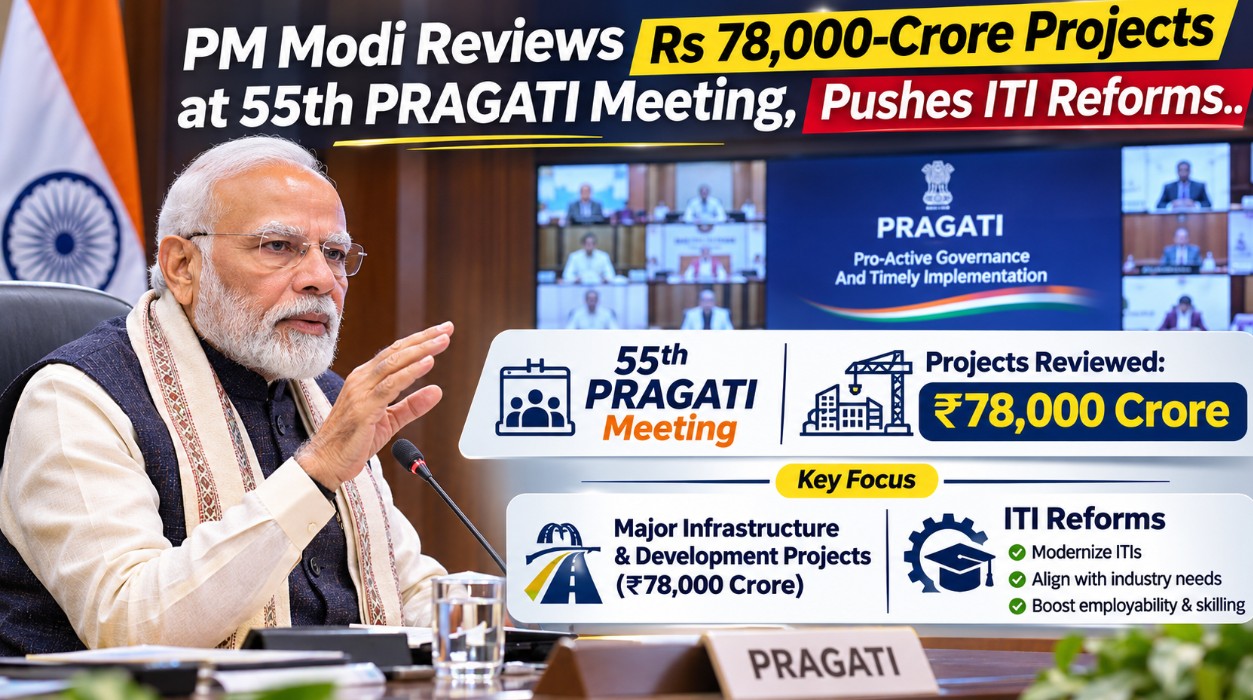
Representational Image
The meeting, held at Seva Teerth, also focused on strengthening India’s Industrial Training Institute (ITI) ecosystem, with particular emphasis on the implementation of the Pradhan Mantri Skilling and Employability Transformation through Upgraded ITIs (PM-SETU) initiative.
The five infrastructure projects reviewed during the meeting span the road, power, coal and railway sectors. The PRAGATI platform brings the Centre and state governments together to resolve administrative bottlenecks, accelerate development projects and improve the implementation of public welfare programmes.
PM stresses timely completion and quality construction
Highlighting the wider economic and social consequences of delayed infrastructure projects, Modi said delays not only increase project costs but also postpone the benefits that citizens, businesses and the economy are expected to receive.
He urged the concerned ministries and state governments to address pending issues with clearly defined responsibilities and realistic timelines.
While reviewing the road infrastructure project, the Prime Minister emphasised speedy execution and called for greater focus on actual outcomes rather than merely the amount of money spent.
During the review of the coal project, he stressed that rehabilitation and resettlement of affected communities must be carried out in a timely and dignified manner alongside project implementation.
On the power sector, Modi suggested exploring innovative models for decentralised solar and wind energy projects, particularly near consumption centres wherever feasible.
He said such initiatives should consider local renewable energy resources and demand patterns to ensure reliable and affordable electricity while reducing pressure on transmission networks.
PM calls for stronger industry-ITI partnerships
A significant part of the meeting was devoted to improving the quality and employment relevance of vocational education.
Reviewing the ITI ecosystem and PM-SETU implementation, the Prime Minister called upon Chief Ministers and Chief Secretaries to take the lead in upgrading training institutions and encouraging greater participation from industry.
He said closer cooperation between state governments, ITIs and companies was essential to ensure that technical education keeps pace with changing industrial requirements.
Modi also urged Public Sector Undertakings (PSUs) to assess their future workforce requirements and establish stronger partnerships with nearby ITIs.
He encouraged PSUs to participate in practical training, provide apprenticeship opportunities and increase recruitment of suitably trained ITI graduates.
Such collaboration, he noted, would help young people gain industry exposure while enabling public sector companies to access skilled manpower suited to their operational needs.
‘Classroom-Company-Career’ approach to transform skilling
Emphasising the need to connect vocational education directly with employment, the Prime Minister advocated a three-stage model of ‘Classroom–Company–Career’, or the 3C approach.
Under this framework, classroom learning would be integrated with practical industrial experience, creating a clearer pathway from technical training to employment and long-term career development.
He also called for ITI courses, training capacity and curricula to be aligned with the specific requirements of industrial clusters and sectors, taking into account existing industries and upcoming investments in different regions.
Focus on jobs closer to home
The Prime Minister highlighted the importance of developing locally relevant skills to expand employment opportunities within people’s own regions.
He observed that stronger connections between ITIs and local employers could help young people find jobs closer to home, reduce distress-driven migration and enable communities to participate more actively in regional economic development.
The emphasis on industry-oriented training, apprenticeships and local employment is expected to strengthen the link between vocational education and workforce requirements.
Through the 55th PRAGATI meeting, the Prime Minister underlined two key priorities for India’s development agenda: accelerating critical infrastructure projects and building a skilled workforce capable of meeting the demands of a growing economy.