

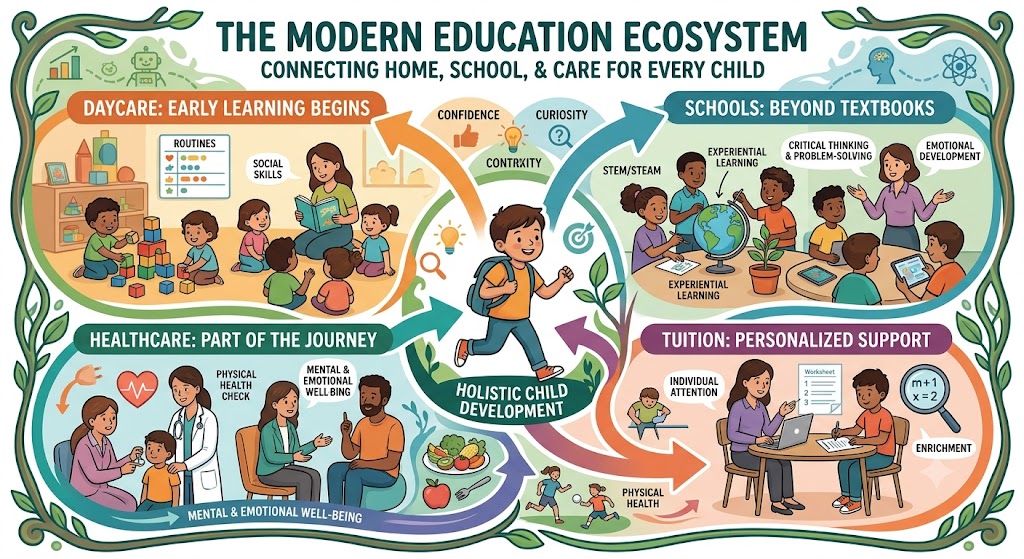
A child’s education does not begin with the first school bell, nor does it end when the school day is over. From the early years of learning to homework, extracurricular activities, nutrition and emotional well-being, several interconnected systems contribute to how a child grows, learns and develops confidence.
For today’s parents, especially those balancing work and family responsibilities, daycare, formal schooling, tuition and healthcare are increasingly becoming parts of one larger ecosystem. Together, they influence not only academic performance but also social skills, emotional development, physical health and independence.
Daycare: Where Early Learning Begins
For many children, daycare is their first experience of spending significant time away from home. This makes it more than a place where children are supervised while parents are at work.
A well-structured daycare can introduce children to routines, group activities and early communication. Simple experiences such as sharing toys, waiting for a turn, participating in activities and interacting with other children help develop important social skills.
Daycare can also encourage curiosity through age-appropriate games, storytelling, art, music and basic learning activities. These experiences create a comfortable bridge between home and formal schooling.
For working parents, extended daycare facilities can provide additional support by aligning childcare with their professional schedules.
Schools Are Moving Beyond Textbooks
As children enter school, their learning environment becomes more structured. But education today is increasingly moving beyond memorising information and reproducing it in examinations.
Classroom learning is gradually incorporating critical thinking, problem-solving, creativity, communication and collaboration. STEM and STEAM-based activities, project work and experiential learning are designed to encourage children to understand concepts and apply them in practical situations.
Emotional development is also becoming an important part of the conversation. Children spend a significant part of their formative years in school, making it an important environment for developing friendships, managing disagreements, building confidence and learning how to express themselves.
The aim is increasingly to prepare children not simply to score marks, but to navigate real-life situations with curiosity and confidence.
Tuition Finds a New Role
Tuition has traditionally been associated with helping students who find particular subjects difficult. That role remains important, but supplemental education has expanded considerably.
With classrooms often accommodating many students, additional learning support can give children more individual attention. A tutor can spend extra time explaining a difficult mathematical concept, helping a child improve reading skills or practising a subject at a pace that suits the learner.
Tuition and online learning are also being used for enrichment. Coding, robotics, advanced mathematics, languages and preparation for specialised examinations have become part of the wider learning landscape.
The key benefit is flexibility. Children can receive additional guidance without necessarily having to follow the same pace as an entire classroom.
Healthcare Is Part of the Learning Journey
Academic learning becomes difficult when a child is struggling with an untreated health or emotional concern. This has encouraged schools and parents to look at education from a more holistic perspective.
Routine health initiatives such as vision and dental screenings can help identify issues that may otherwise affect a child’s classroom experience. Nutrition and physical activity are equally important during the growing years.
Mental and emotional well-being has also received greater attention. School counsellors and trained professionals can provide support when children experience academic pressure, friendship-related difficulties or other challenges.
This does not mean schools replace families or healthcare providers. Instead, schools can become an important point where concerns are noticed early and families are guided towards appropriate support.
When Education and Well-Being Come Together
The most effective learning environment is rarely created by one institution alone. Home, daycare, school, supplemental education and healthcare each play different but connected roles.
Daycare can help children become comfortable in group environments and develop early social skills. Schools provide a structured academic and social environment. Tuition can offer personalised academic support, while healthcare helps ensure that physical and emotional well-being does not become a barrier to learning.
This interconnected approach is particularly relevant as parents increasingly look beyond report cards when thinking about their children’s development.
Building More Than Academic Success
A child who learns how to communicate, cooperate, solve problems, stay physically active and manage emotions is developing skills that extend far beyond the classroom.
That is why the modern education ecosystem is increasingly focused on the whole child. Academic knowledge remains important, but it works alongside social development, emotional confidence, healthy routines and personalised support.
Ultimately, raising and educating a child is not the responsibility of a single institution. It is a shared journey involving parents, educators, caregivers, healthcare professionals and the wider community.
When these pieces work together, education becomes more than preparation for the next examination. It becomes a foundation for helping children grow into confident, curious, healthy and capable individuals.