

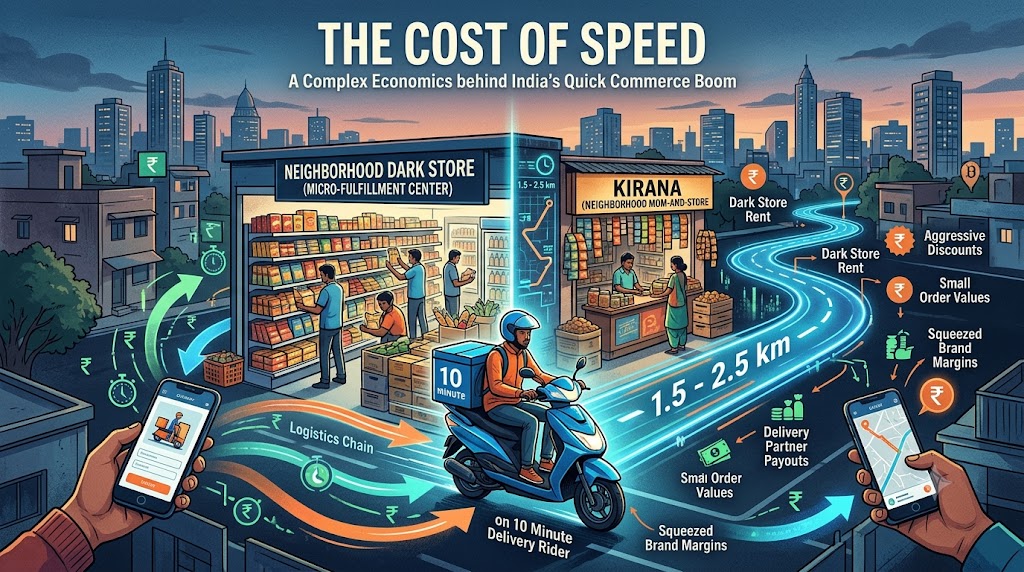
India’s quick commerce industry is transforming urban retail by making groceries, household essentials and everyday products available within minutes. What began as a convenient way to buy last-minute necessities has evolved into a competitive business model built around speed, neighbourhood fulfilment centres and changing consumer expectations. However, behind the promise of faster deliveries lies a complex cost structure that raises important questions about profitability, worker welfare and the future of retail.
The business of instant delivery requires substantial investment in dark stores, inventory, technology, delivery networks and customer acquisition. While consumers benefit from convenience, the financial burden is distributed across several stakeholders, including shoppers, brands, neighbourhood retailers, delivery partners and investors.
As competition intensifies, the industry’s biggest challenge is becoming increasingly clear: delivering products faster is only one part of the equation. Building a business that can sustain those speeds without eroding margins or transferring excessive costs to others is the real test.
The Economics Behind the Quick Commerce Boom
Quick commerce has changed the traditional retail fulfilment model by bringing inventory closer to customers. Instead of shipping products from large warehouses, platforms operate smaller neighbourhood fulfilment centres that allow orders to be picked, packed and dispatched rapidly.
This arrangement can shorten delivery distances, but it also requires businesses to maintain multiple locations across a city. Rent, electricity, staffing, inventory management, technology and delivery operations all add to operating expenses.
The challenge becomes more pronounced when customers place small orders. Delivering a few everyday items still requires order processing, packaging and a delivery partner, even when the value of the basket is relatively low. Unless sufficient revenue is generated from the transaction, the cost of fulfilling it can leave little contribution towards the company’s broader expenses.
Platforms attempt to offset these costs through product margins, delivery and platform fees, advertising revenue, supplier partnerships and higher order volumes. Yet aggressive discounts and the pressure to offer rapid service can make profitability difficult to achieve.
The industry’s long-term success will depend on whether companies can improve order density, manage inventory efficiently and generate enough revenue from each transaction to support their operating networks.
Consumers Pay for Convenience in More Ways Than One
For consumers, quick commerce offers an obvious benefit: saving time. A household that runs out of milk, cooking ingredients or personal care products can replenish supplies without making a separate trip to the market.
However, the total cost of an order can extend beyond the displayed product prices. Platform fees, delivery charges, handling costs and small-cart fees may increase the final bill, depending on the platform and the terms of the transaction.
Product prices and discounts also vary. Some purchases may be cheaper online, while others may cost less at a neighbourhood retailer. Customers therefore need to compare the complete bill rather than assume that rapid delivery is always the most economical option.
Convenience can also influence shopping habits. When ordering a single item becomes effortless, consumers may make more frequent purchases than they otherwise would. Small expenses can accumulate over time, particularly when impulse buying and promotional offers encourage customers to add products they did not originally plan to purchase.
This does not mean quick commerce is inherently expensive. For busy households, elderly consumers or people who need an essential item urgently, the time saved may justify the additional cost. The concern is whether frequent use gradually increases household spending without customers recognising the cumulative impact.
For the industry, maintaining consumer trust will require clear pricing, transparent fees and a value proposition that extends beyond speed alone.
Brands and Retailers Face Pressure on Profit Margins
Quick commerce platforms offer brands an opportunity to reach customers at the moment of purchase. A consumer searching for snacks, beverages, personal care products or household essentials can discover and buy a product almost immediately.
For emerging brands, this can provide access to urban customers without building an extensive physical retail network. Established companies can also use these platforms to promote new products, run targeted campaigns and respond quickly to changing demand.
However, access to customers comes with commercial costs. Depending on the agreement, brands and sellers may face platform commissions, promotional expenses, advertising charges and other fees. Competition for visibility can make these expenses particularly important for smaller businesses.
A brand may generate higher sales through quick commerce but still struggle to improve profitability if the cost of discounts, advertising and fulfilment-related charges absorbs much of its margin.
This creates a difficult balancing act. Businesses want to participate in a rapidly growing sales channel, but they must ensure that incremental revenue produces a meaningful financial return.
For smaller manufacturers, the priority is to evaluate the full cost of selling through each platform. Strong sales figures alone do not guarantee a sustainable business if the margins remaining after promotional and platform expenses are too narrow.
Over time, commercial relationships that balance platform growth with supplier profitability will be essential to maintaining a diverse and competitive consumer market.
Delivery Partners Carry the Human Cost of Speed
The quick commerce model also depends on delivery partners who connect neighbourhood fulfilment centres with customers. Their work is central to the service, yet the economics of delivery can place considerable pressure on earnings and working conditions.
Payments may depend on completed orders, distance, incentives and other platform-specific arrangements. Workers may also bear expenses related to fuel, vehicle maintenance, mobile connectivity and other requirements of the job. Consequently, gross earnings do not necessarily reflect the amount left after work-related costs.
Time pressure presents another concern. Congested roads, bad weather, difficult addresses and unpredictable demand can make rapid deliveries challenging. Delivery targets should not create incentives for unsafe driving or encourage workers to take unnecessary risks.
The discussion around quick commerce therefore needs to include more than customer convenience and platform profitability. It must also consider road safety, insurance, income predictability and access to effective grievance mechanisms.
A delivery network cannot remain sustainable if the people operating it must absorb disproportionate financial and physical risks. Responsible workforce practices and realistic delivery expectations are important to the long-term health of the industry.
Investors Are Funding the Race for Scale
Quick commerce companies have invested heavily in fulfilment infrastructure, technology, customer acquisition and market expansion. In a competitive market, businesses may accept short-term losses to attract customers, increase order volumes and establish a stronger presence in high-demand neighbourhoods.
The commercial logic is that scale can eventually improve efficiency. More orders within a limited area may allow delivery resources to be used more effectively, while higher purchasing volumes can strengthen supplier relationships.
However, rapid expansion does not automatically lead to profitability. Companies must still cover the cost of operating dark stores, managing inventory, delivering orders and attracting customers. Excessive discounting or opening facilities ahead of demand can weaken financial performance.
Investors therefore need to look beyond headline growth figures. Order volumes and market share matter, but so do contribution margins, store utilisation, customer retention and the company’s ability to reduce operating losses.
The next stage of competition is likely to place greater emphasis on disciplined expansion and better unit economics. Platforms that can deliver convenience efficiently will be better positioned than those that depend indefinitely on expensive promotions.
Why Small Orders Make the Business More Challenging
One of the biggest financial challenges in quick commerce is the relationship between basket size and fulfilment costs. A customer purchasing a few low-priced items still requires the platform to process and deliver an order.
Consider an illustrative transaction worth ₹500. The platform may earn revenue through product margins and applicable fees, but must also cover picking, packing, delivery and other operating expenses.
If the contribution remaining from the transaction is too small, the company may struggle to cover the wider costs of maintaining its network.
This explains why platforms experiment with minimum order values, small-cart charges, product bundles and promotional strategies designed to encourage larger purchases. The objective is to increase the revenue generated from each delivery without making the service unattractive to customers.
Higher basket values can help spread certain fulfilment costs across more products, although the precise benefits depend on the order mix and operational efficiency.
For quick commerce businesses, the goal is not simply to process more transactions. It is to build a system in which each additional order contributes meaningfully to financial sustainability.
The Impact on India’s Neighbourhood Retailers
The growth of quick commerce is reshaping competition for neighbourhood kirana stores and other small retailers. Digital platforms attract customers through convenience, product selection, app-based offers and rapid delivery, creating pressure on traditional shops to adapt.
Yet local retailers retain important advantages. They often understand customer preferences, maintain personal relationships and can offer flexible service within their communities. Some provide informal credit or cater to needs that may not fit neatly into a platform’s standard ordering system.
Small retailers can respond by improving product availability, offering neighbourhood delivery, accepting digital payments and using messaging platforms to manage customer orders. Partnerships with digital marketplaces may provide another route to reach new buyers, where the commercial terms are suitable.
The outcome will depend on local market conditions and the ability of businesses to compete on service, price and reliability. Quick commerce and traditional retail do not necessarily serve every customer in the same way.
The broader challenge is to ensure that competition encourages better service and efficiency without making it unnecessarily difficult for smaller businesses to remain viable.
Building a More Sustainable Quick Commerce Model
For the industry to achieve lasting growth, companies will need to improve operational efficiency while maintaining a reasonable balance between convenience, cost and service quality.
Better demand forecasting can reduce excess inventory and product wastage. Locating fulfilment centres according to genuine customer demand can improve utilisation, while efficient picking and delivery systems can reduce the cost of processing individual orders.
Platforms can also refine their product ranges, develop stronger supplier relationships and encourage repeat purchases without relying excessively on discounts. Transparent fees and clear communication about delivery conditions can help customers understand the value they receive.
At the same time, fairer commercial arrangements with brands and responsible working conditions for delivery partners can strengthen the industry’s foundations.
The objective should not be to eliminate the cost of convenience, which is impossible, but to manage it more efficiently and distribute it transparently among the participants who benefit from the service.
The Road Ahead: Speed Must Deliver Sustainable Value
Quick commerce has become an influential part of India’s retail transformation, creating opportunities in digital payments, warehousing, logistics, advertising and urban distribution. It has also raised consumer expectations about how quickly everyday products should arrive.
But the promise of a 10-minute delivery comes with financial and operational demands. Consumers may pay through additional charges or more frequent purchases, brands may face pressure on margins, delivery partners may bear work-related risks, and investors must finance the infrastructure required to sustain growth.
The burden differs across companies and transactions, but the underlying issue remains the same: convenience must generate enough value to justify its cost.
For consumers, this means making informed purchasing decisions. For brands and retailers, it means evaluating profitability rather than sales volume alone. For delivery platforms, it means building efficient networks and adopting responsible business practices.
The future of quick commerce will depend not just on how fast a product reaches the customer, but on whether the entire business model can remain profitable, transparent and fair to the people who make that speed possible.