

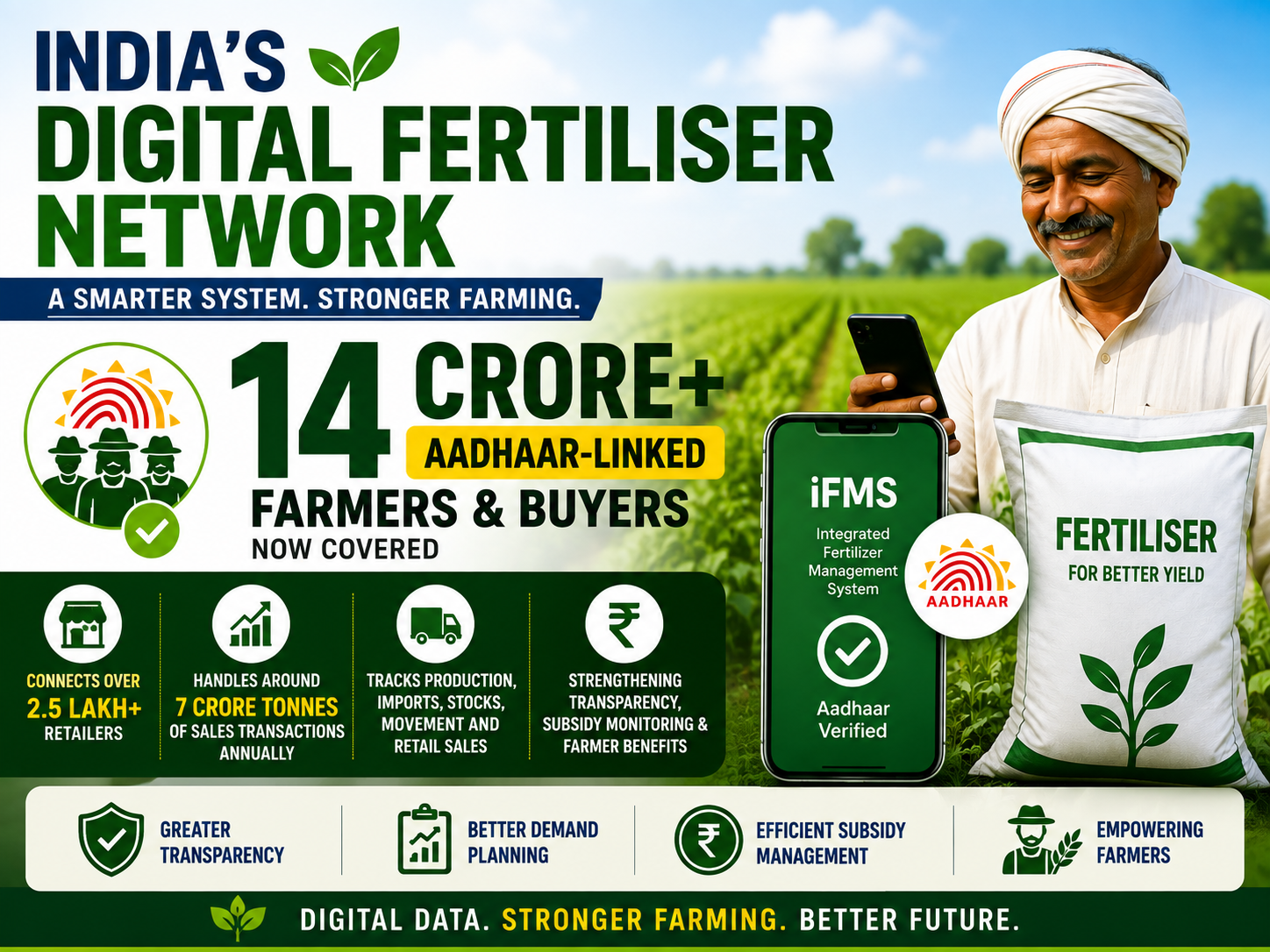
New Delhi, August 30: India’s digital infrastructure for fertiliser distribution has expanded to cover more than 14 crore Aadhaar-linked farmers and fertiliser buyers, strengthening the government’s ability to track the movement and sale of subsidised agricultural inputs across the country.
The Integrated Fertilizer Management System (iFMS), developed with technical support from the National Informatics Centre (NIC) for the Department of Fertilizers, has grown into a nationwide digital platform covering multiple stages of the fertiliser supply chain. The system tracks production, imports, dispatches, transportation, inventories and retail sales, providing authorities with greater visibility into the availability and movement of fertilisers.
The platform currently connects more than 2.5 lakh fertiliser retailers and processes around 7 crore metric tonnes of fertiliser sales transactions each year, highlighting the scale at which digital systems are being deployed to manage one of India’s most critical farm inputs.
The expansion of iFMS is aimed at improving transparency in fertiliser distribution and enabling government agencies to respond more quickly to changes in regional demand and supply.
Digital dashboards provide information on fertiliser stocks and movement at different administrative levels, from the national and state levels down to districts and individual retail outlets. This allows officials to monitor inventories and identify potential supply pressures or unusual purchasing patterns.
The availability of transaction-level information is also expected to support more effective planning during periods of heightened agricultural demand, when fertiliser consumption typically rises.
The government’s next phase of digital integration involves connecting fertiliser purchase information with broader agricultural databases, including land and crop records.
The Department of Fertilizers has already worked towards integrating iFMS with state-level agricultural databases such as Haryana’s Meri Fasal Mera Byora, while exploring integration with the national AgriStack framework.
Such linkages could enable authorities to analyse fertiliser consumption in relation to factors including crop patterns, landholdings, geographical regions and the type of fertiliser being purchased.
This could improve demand forecasting and help policymakers better understand how fertilisers are being consumed across different agricultural regions. At the same time, the effectiveness of such systems will depend on the availability and quality of underlying land and crop data.
Digitalisation has also become an important component of India’s fertiliser subsidy framework. The government provides substantial financial support to keep key fertilisers affordable for farmers, with annual fertiliser subsidy expenditure running into nearly ₹2 lakh crore.
Under the fertiliser Direct Benefit Transfer (DBT) mechanism, subsidy payments to manufacturers and importers are linked to actual retail sales recorded through Point of Sale (PoS) devices.
The system provides a digital trail from the retail transaction to the subsidy claim, helping improve accountability and reduce the scope for leakages or irregularities in the distribution chain.
Farmers purchasing subsidised fertilisers through registered retailers receive transaction records generated through the PoS system, while government agencies gain access to data that can be used to monitor sales and subsidy flows.
The rapid expansion of the digital fertiliser network signals a broader change in the government’s approach to agricultural input management.
Rather than functioning only as a mechanism for recording sales, iFMS is increasingly being positioned as a data and decision-support platform. The large volume of transactions generated through the network can provide insights into regional demand, stock levels, distribution patterns and purchasing behaviour.
For policymakers, this information can potentially help anticipate shortages, improve supply planning and coordinate production and imports with actual market requirements.
The integration of fertiliser data with land and crop information could take this process further by providing a more detailed picture of input requirements at the farm and regional level.
The scale of the iFMS network reflects India’s broader effort to use digital technology to improve the delivery of agricultural services and government support.
With more than 14 crore Aadhaar-linked buyers and a nationwide network of retailers, the system has created a large digital footprint for monitoring fertiliser distribution. The government’s focus is now shifting towards making greater use of this data to improve forecasting, supply-chain management and subsidy administration.
As India continues to digitise its agricultural ecosystem, the integration of fertiliser transactions with farmer, land and crop databases could become an important tool for improving the efficiency and transparency of farm-input distribution.
For the agricultural economy, the development represents a significant move towards data-driven fertiliser management, where digital records can increasingly influence how supplies are planned, distributed and monitored across the country.