

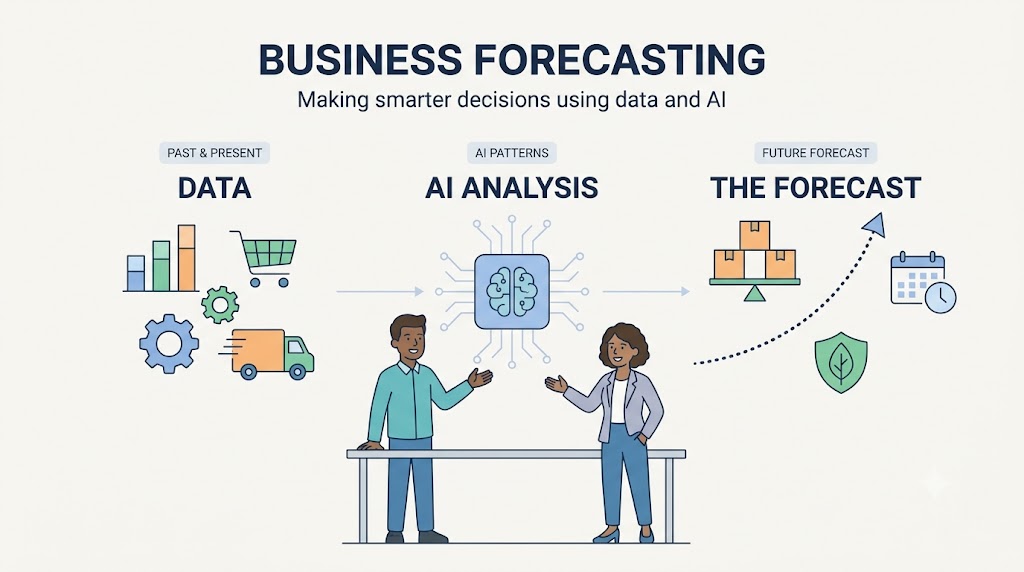
Forecasting in business means estimating what may happen in the future by analysing past performance, current trends and available market information. It helps companies make informed decisions about how much to produce, which products to stock, how much money to allocate and when to invest in new opportunities.
In an increasingly competitive market, accurate forecasting can make a significant difference to business performance. Ordering too much inventory can increase storage costs and create waste, while ordering too little can lead to lost sales and dissatisfied customers. Artificial intelligence (AI) is helping businesses address these challenges by analysing large volumes of data, identifying demand patterns and improving the way companies plan for the future.
From retail and manufacturing to food services and logistics, AI-powered forecasting is becoming a valuable tool for businesses seeking to control costs, use resources efficiently and achieve sustainable growth.
What Does Forecasting Mean in Business?
Business forecasting is the process of predicting future business outcomes using historical data, current conditions and reasonable assumptions. These predictions may relate to sales, customer demand, revenue, expenses, inventory requirements or market growth.
For example, a grocery store may examine previous sales to estimate how much milk, bread and fresh produce customers are likely to buy next week. A manufacturer may forecast demand before deciding how many products to produce, while a small business may estimate future revenue to plan its budget and manage cash flow.
Forecasting does not guarantee that predictions will be correct. Instead, it gives businesses a practical basis for making decisions and preparing for different possibilities.
Traditional forecasting often relies on spreadsheets, past sales figures and employees’ experience. Although these methods remain useful, they can become less effective when demand changes quickly or multiple factors influence customer behaviour.
This is where AI can offer additional support.
How AI Is Changing Business Forecasting
AI-powered forecasting uses machine learning and predictive analytics to examine historical records alongside new information. Depending on the available data, these systems can consider sales trends, inventory levels, customer preferences, seasonal changes, weather conditions and other market signals.
By identifying relationships across these sources, AI can help businesses develop more detailed demand estimates and update predictions as conditions change.
For instance, a retailer may notice an increase in demand for a particular product following a promotional campaign. An AI forecasting system can use recent sales information to help the business assess whether to replenish inventory, adjust future orders or modify its marketing strategy.
The benefit is not simply faster analysis. It is the ability to turn business data into more useful decisions about purchasing, production and resource allocation.
How AI Demand Forecasting Helps Reduce Waste
Preventing Excess Inventory
One of the biggest challenges for businesses is maintaining the right amount of stock. Excess inventory ties up working capital, occupies storage space and may become obsolete or expire before it can be sold.
AI demand forecasting helps companies estimate how much stock they may need over a particular period. These predictions can guide purchasing decisions and help businesses avoid ordering significantly more products than customers are likely to buy.
For retailers, this can reduce the accumulation of unsold goods. For manufacturers, it can help align production schedules with expected orders and reduce unnecessary use of raw materials.
Reducing Product Shortages
Having too little stock can be just as costly as having too much. When popular products are unavailable, businesses risk losing sales and sending customers to competitors.
AI can help identify changes in purchasing patterns and highlight products that may require replenishment. By combining demand estimates with current inventory and supplier lead times, businesses can plan stock levels more effectively.
Although forecasts cannot eliminate every shortage, they can help companies respond earlier to potential changes in demand.
Cutting Food and Perishable Product Waste
Food businesses face particular difficulties because demand can fluctuate daily while products have limited shelf lives. Restaurants, supermarkets and food distributors must estimate how much to prepare, purchase or display without creating unnecessary surplus.
AI forecasting can help analyse previous sales, seasonal patterns, weather conditions and other relevant factors to estimate likely demand. This information can support better purchasing decisions, meal preparation and stock rotation.
For example, a restaurant may use historical order patterns to estimate ingredient requirements for different days of the week. Better estimates can reduce unnecessary purchases, lower spoilage and help businesses manage food costs.
Improving the Use of Resources
Forecasting also affects labour, transportation, energy and production capacity. When companies have a clearer understanding of expected demand, they can plan staff schedules, coordinate deliveries and allocate materials more efficiently.
This can reduce avoidable operational expenses while helping businesses make better use of the resources they already have.
The Business Benefits of Accurate Forecasting
Effective forecasting supports several important business objectives.
-
Better financial planning: Companies can estimate future revenue and expenses more realistically, helping them prepare budgets and manage cash flow.
-
Lower operating costs: Better purchasing and production decisions can reduce unnecessary storage, handling and disposal expenses.
-
Improved customer satisfaction: Maintaining suitable inventory levels helps businesses meet customer demand more consistently.
-
More efficient supply chains: Forecasts can improve coordination between suppliers, warehouses, manufacturers and retailers.
-
Reduced waste: Companies can limit excess production, unused materials and unsold or expired products.
-
Stronger decision-making: Business owners can use data-driven insights to evaluate risks, plan investments and respond to changing market conditions.
The actual results depend on data quality, the forecasting method and how effectively businesses act on the predictions.
Why Forecasting Matters for Small Businesses
Forecasting is not just for large corporations with sophisticated technology. Small retailers, restaurants, distributors and manufacturers can also benefit from understanding their likely future demand.
A small retailer can use past sales to identify fast-moving and slow-moving products. A bakery can estimate daily production requirements to avoid preparing more items than customers are likely to purchase. A service business can forecast staffing needs during busy periods.
Businesses do not necessarily need to adopt an advanced AI system immediately. They can begin with accurate sales records, simple forecasting tools and regular reviews of actual performance. As their operations grow, AI-powered software can help analyse larger datasets and identify patterns that are harder to detect manually.
Starting with a specific problem, such as reducing food waste or preventing frequent stockouts, allows businesses to measure the benefits before making a larger investment.
Challenges Businesses Should Consider
Although AI can improve forecasting, it cannot predict the future with complete certainty. Unexpected events, sudden changes in customer preferences, supplier disruptions and incomplete records can affect the accuracy of predictions.
Businesses may also face implementation costs, technology integration challenges and a need to train employees. Forecasts must be reviewed regularly to determine whether they reflect current market conditions.
The most effective approach combines AI-generated insights with human judgement. Employees understand operational realities that may not be fully captured in the data, while forecasting tools can help them identify patterns and evaluate alternatives.
Companies should also measure results using practical indicators such as forecast accuracy, inventory costs, waste levels and product availability. This makes it easier to identify where forecasting is delivering value and where improvements are needed.
Conclusion
Forecasting in business is about making informed decisions today by estimating what may happen tomorrow. It helps companies prepare for customer demand, manage finances, control inventory and allocate resources more effectively.
With AI, businesses can analyse more information, recognise changing patterns and update their plans more quickly. These capabilities can help reduce excess stock, prevent product shortages, limit waste and improve operational efficiency.
However, successful forecasting depends on more than technology. Reliable data, regular monitoring and sound business judgement remain essential. Companies that combine these fundamentals with AI-driven insights can make better-informed decisions, respond more confidently to uncertainty and build a stronger foundation for sustainable growth.