

For generations, festivals in India have meant crowded markets, new clothes, family gatherings, elaborate meals and homes lit up for the occasion. Today, there is another element increasingly finding a place in the festive calendar, travel.
A long weekend is enough for some families to plan a road trip. Others use the festive break to return to their hometowns, visit a temple, meet relatives or discover a destination they have never seen before. For younger travellers, the holiday may mean a quick getaway with friends, a stay at a boutique property or an experience centred around food, culture and nature.
What may look like a personal choice is becoming an important economic trend.
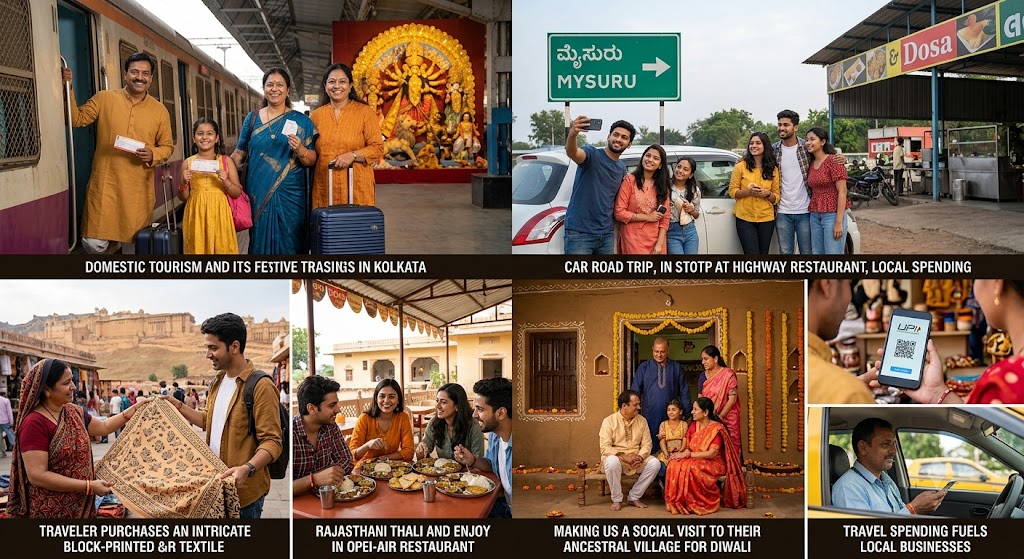
When people travel, their spending does not stop with a ticket or hotel room. It moves through restaurants, taxis, fuel stations, local markets, tourist attractions, guides, handicraft shops and small businesses. In that sense, every holiday creates a chain of economic activity around it.
India’s love for travel is increasingly domestic
India’s tourism story is being powered not only by international visitors but also by the sheer scale of domestic travel.
Government data shows that India recorded around 4.29 billion domestic tourist visits in 2025. Tourism has also become a significant contributor to employment and economic activity, with the sector estimated to have contributed around 5.22 per cent to GDP and supported approximately 84.63 million direct and indirect jobs in 2023-24.
The numbers become more meaningful when viewed through everyday travel.
A family travelling from Kolkata to Puri may spend on a train ticket, hotel, meals, local transport and shopping. A group driving from Bengaluru to Mysuru may stop at restaurants, fuel stations and attractions along the way. A traveller visiting Jaipur may spend on accommodation, heritage sites, local crafts and regional food.
Each individual expense may appear small. Collectively, however, millions of such transactions create a sizeable economic movement.
A festival holiday can mean many different things
There is no single definition of a festive holiday in India.
For some, it is a pilgrimage. For others, it is a visit to parents or relatives. Some prefer a beach or hill destination, while others simply want to escape the city for two or three days.
The latest Domestic Tourism Expenditure Survey reflects this diversity. Pilgrimage and religious travel accounted for about 48 per cent of overnight trips for specified purposes during the survey period. Social visits were another important reason for travel, while shopping featured prominently in same-day trips.
This is one of the distinctive strengths of India’s travel economy. A single journey can combine several purposes — faith, family, food, shopping and leisure.
A person may travel to a temple and buy local handicrafts. A family may visit relatives and spend a weekend sightseeing. A pilgrimage can turn into a wider local tourism experience.
The boundaries between travel categories are becoming increasingly fluid.
From sightseeing to collecting experiences
Perhaps the most noticeable change is in what people want from a holiday.
Travellers are increasingly looking for experiences rather than simply accommodation. A memorable local meal, a walk through an old market, a cultural performance, a nature trail, a heritage property or a quiet homestay can become as important as the destination itself.
This shift is particularly visible among younger travellers, who often prefer shorter but experience-rich breaks.
Hotels and tourism businesses are responding by offering packages built around local culture, wellness, food, adventure and personalised experiences. For travellers, this can make even a short trip feel meaningful.
For local communities, the benefits can be even greater.
A traveller who chooses a local restaurant instead of a chain, stays at a family-run homestay or buys directly from an artisan is putting money into the local economy. Tourism therefore has the ability to connect visitors directly with small businesses.
The festive wallet is getting more diverse
Festive spending in India has traditionally revolved around shopping.
Gold, clothing, gifts, electronics, sweets, groceries and home decoration remain important categories. But travel is increasingly competing for a place in the same household budget.
For many people, a holiday has become a form of spending that offers something different: an experience rather than another possession.
A family may spend less on a large celebration at home and put part of that budget towards a short trip. A group of friends may choose a weekend getaway instead of several expensive evenings in the city.
This does not signal the end of festive shopping. Instead, it shows how consumer priorities are expanding.
The festive wallet is becoming more flexible, with spending divided between products, experiences, food, entertainment and travel.
When travel becomes expensive, people change the way they travel
The growing appetite for holidays does not mean travellers are willing to spend without limits.
Higher airfares, hotel prices and fuel costs can make festive travel expensive, particularly during peak periods. On some routes, domestic airfares have seen significant increases as demand rises and available capacity remains limited.
The response is often surprisingly practical.
Travellers may take trains instead of flights, drive to destinations within a few hundred kilometres, shorten a seven-day holiday to a three-day break or choose a homestay over a luxury hotel.
This creates an interesting dynamic in the travel economy. Higher prices may influence the form of travel without necessarily eliminating the desire to travel.
For businesses, that means there is growing demand for products across different price points — from luxury resorts to budget hotels, premium flights to trains, and organised tours to self-planned road trips.
The opportunity beyond India’s famous destinations
The next phase of India’s tourism growth may not come only from its best-known holiday spots.
Goa, Jaipur, Manali, Udaipur and other established destinations will continue to attract travellers, but rising demand is also encouraging people to look for quieter and less-explored places.
India has thousands of destinations with their own food traditions, landscapes, festivals, temples, heritage buildings and local crafts.
A small coastal town can benefit when visitors stay for a weekend. A heritage village can earn from guided tours. A local artisan can find new customers. A family-run restaurant can serve more visitors.
This is where tourism becomes particularly valuable for regional economies: the money spent by visitors can reach businesses that may have very little connection with the formal tourism industry.
Hotels are preparing for stronger domestic demand
The hospitality industry is already reflecting this growing appetite for travel.
ICRA expects Indian hospitality revenues to rise 7–9 per cent in FY2027, supported by domestic leisure travel, weddings, business travel and meetings and events. Premium hotel occupancy is expected to remain around 72–74 per cent.
The message is clear. India’s hotel industry is no longer relying solely on foreign tourists or large business events.
The domestic traveller has become an important customer in their own right.
Recent estimates have placed domestic visitor spending at around ₹17.7 lakh crore in 2025, highlighting the enormous purchasing power associated with travel within the country.
Every journey creates a small economic chain
The economic impact of a holiday becomes clearer when we follow the money.
A traveller books a room. The hotel pays its employees and buys supplies. The guest eats at a restaurant, which purchases food from suppliers. A taxi driver earns from local trips and spends on fuel and vehicle maintenance. A tourist buys a handicraft, supporting an artisan and the wider supply chain.
The original travel expense keeps moving.
That is why tourism is often viewed as a multiplier sector. Its impact can extend across hospitality, transport, retail, food services, entertainment and local employment.
And the effect is not limited to expensive holidays. Millions of modest trips can collectively create a large economic impact.
Festivals may become an even bigger travel season
India’s festive calendar offers a natural advantage to the travel industry.
Diwali, Dussehra, Durga Puja, Christmas, New Year, regional festivals and long weekends create multiple opportunities for short breaks throughout the year. Better roads, expanding air connectivity, improved railway services and digital travel platforms are making it easier for people to plan those journeys.
The result is a new relationship between festivals and travel.
People still want the warmth of family celebrations, traditional food and familiar rituals. But they are increasingly willing to add a journey to the experience.
That may be the most interesting story behind India’s festive travel boom.
A holiday is no longer simply time away from work. It has become a form of consumption, an opportunity for discovery and, increasingly, a source of income for thousands of businesses and workers.
As more Indians choose to travel during the festive season, the economic journey continues long after the suitcase is unpacked — spreading spending from airports and railway stations to hotels, restaurants, markets, local businesses and communities across the country.