

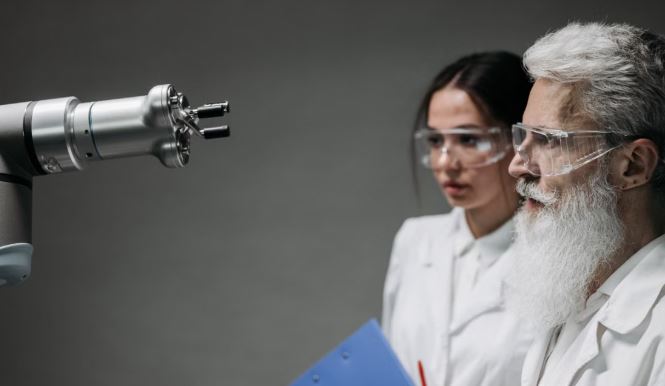
Pic Credit: Pexel
The workplace is undergoing a fundamental change as artificial intelligence, automation and robotics become part of everyday business operations. Tasks that once required hours of manual effort can now be completed faster with digital tools, while machines are increasingly capable of supporting decisions, analysing information and managing complex processes. Yet this transformation is not simply about replacing human effort with technology. It is about finding better ways for people and machines to work together.
For businesses, human-machine collaboration is emerging as an important part of improving productivity, managing costs and responding to changing market demands. Technology can handle repetitive tasks and process information at scale, while employees contribute experience, creativity, judgement and an understanding of customer needs. When these strengths are combined effectively, organisations can improve operational performance without losing the human insight that drives meaningful decisions.
The challenge is to ensure that technological progress translates into better work, stronger businesses and new opportunities for employees.
From Automation to Collaboration
Automation has traditionally focused on making routine tasks faster and more consistent. The growing use of AI is expanding that role, allowing technology to assist with research, planning, customer support, data analysis and problem-solving.
This is changing how responsibilities are divided across workplaces. Rather than handling every task independently, employees can use digital systems to gather information, identify patterns and prepare initial assessments. They can then apply their knowledge to evaluate the results, address exceptions and make decisions that require context and accountability.
This approach can be valuable across industries. Manufacturers can use intelligent systems to monitor production, logistics companies can improve inventory planning, and service businesses can use AI to support customer interactions. In each case, the greatest benefit comes when technology complements employees’ capabilities instead of being treated as a substitute for them.
Productivity Gains Must Translate Into Business Value
For businesses, adopting new technology is only the first step. The real test is whether it improves performance in measurable ways.
Human-machine collaboration can help reduce repetitive workloads, improve consistency and shorten the time needed to complete routine processes. Employees may then have more time to focus on customer relationships, quality improvement, planning and innovation. Better use of information can also help managers identify inefficiencies and respond more quickly to changing business conditions.
However, these benefits are not guaranteed. Technology can add costs and complexity when systems are poorly integrated, employees are inadequately trained or the business problem has not been clearly defined. Smaller enterprises, in particular, need to weigh implementation costs against realistic gains in productivity and revenue.
A practical strategy begins with identifying specific operational challenges, testing suitable tools and measuring their impact before expanding their use. The objective should be better business outcomes, not automation for its own sake.
Human Skills Are Becoming More Valuable
As machines take on a wider range of routine and data-intensive tasks, the qualities people bring to work remain critical. Creativity, communication, critical thinking, leadership and emotional intelligence help employees navigate situations that cannot be resolved through data alone.
Human judgement is also essential when technology produces incomplete, misleading or inaccurate information. AI systems can assist with analysis, but their output still needs to be checked against real-world conditions, organisational priorities and ethical considerations.
For employers, this means that technical ability must be developed alongside interpersonal and analytical skills. Employees who understand both their profession and the technology available to them can help businesses make more informed decisions and adapt to new demands.
The future workplace will not be defined by technical expertise alone. It will increasingly reward the ability to combine digital knowledge with sound judgement and practical experience.
Reskilling Becomes a Business Priority
The shift towards technology-enabled work is changing the skills businesses need. Employees may be expected to work with AI tools, interpret data, supervise automated processes or manage tasks that require greater decision-making responsibility.
This makes continuous training an important part of workforce planning. Businesses that invest in reskilling can help employees adjust to changing roles while retaining valuable organisational knowledge. Training also gives workers a clearer path to participating in the benefits of technological change.
The transition requires particular attention to entry-level employment. When routine tasks are automated, young workers may lose some of the opportunities through which they traditionally gain experience. Employers will need to create alternative learning pathways, including supervised projects, practical training and opportunities to develop professional judgement.
Reskilling should therefore be viewed not merely as an employee benefit, but as an investment in productivity, workforce stability and long-term competitiveness.
New Opportunities Across the Economy
The expansion of human-machine collaboration is creating demand for services that help businesses adopt and manage technology. AI implementation, software integration, cybersecurity, robotics maintenance, employee training and workflow redesign are becoming important areas of business activity.
These opportunities extend beyond large technology companies. Small businesses and specialist service providers can support organisations that lack the resources to develop sophisticated systems internally. Training institutions can also play a larger role in preparing workers for technology-enabled jobs.
At the same time, new opportunities will emerge for employees who can connect technological capabilities with practical industry knowledge. Professionals who understand how businesses operate and how digital tools can improve those operations may be well placed to take on broader responsibilities.
The scale of these opportunities will depend on affordability, access to training and the ability of businesses to adopt technology responsibly. Ensuring that smaller enterprises and workers can participate will be important to making the economic benefits more widely shared.
Building Trust in the Technology-Enabled Workplace
Greater use of AI also brings responsibilities. Businesses must consider data protection, cybersecurity, potential bias and the consequences of relying on automated recommendations. Clear rules are needed to establish which decisions can be supported by machines and which require human approval.
Employees should also understand how new systems affect their responsibilities and how their performance is assessed. Involving workers in implementation can help identify practical concerns, improve adoption and build confidence in new processes.
Ultimately, successful collaboration depends on trust. Technology must be reliable, its limitations understood and responsibility for important decisions clearly defined. Businesses that overlook these factors risk undermining employee confidence and weakening the very productivity gains they hope to achieve.
Conclusion
The future of work will depend on more than the speed at which businesses adopt artificial intelligence and automation. It will depend on how thoughtfully they combine technological capabilities with human experience, judgement and creativity.
For businesses, the priority is to use technology where it solves real problems, prepare employees for changing responsibilities and ensure that productivity improvements create lasting value. For workers, developing digital skills alongside critical thinking, communication and adaptability will become increasingly important.
Human-machine collaboration represents a shift towards a more connected way of working, where technology supports human potential rather than defining its limits. Businesses that recognise the value of both are better positioned to build resilient teams, improve performance and navigate the changing demands of the modern economy.