

Sep 10, 2026: Every innovation starts with something simple: noticing that something could work better.
For the young innovators of Samsung Solve for Tomorrow 2026, the next question is harder: how do you turn that observation into something real?
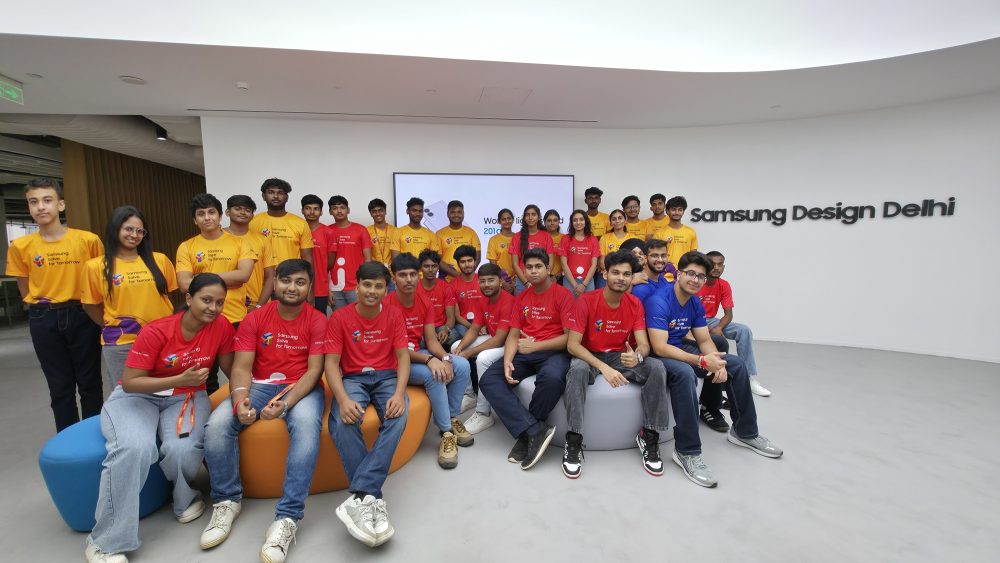
During an immersive Innovation Bootcamp, the Top 40 stepped inside Samsung’s innovation ecosystem across Gurugram, Delhi, Noida and Bengaluru to see how ideas are understood, designed, engineered, tested and refined.
Their journey took them through Samsung’s Head Office in Gurugram, Samsung Design Delhi, Samsung R&D Institute India-Noida (SRI-Noida) and Samsung R&D Institute India-Bengaluru (SRI-B) — bringing them closer to the people, processes and technologies behind some of Samsung’s innovations.
Addressing the young innovators, JB Park, President and CEO, Samsung South West Asia, spoke about where the next generation of ideas could come from.
“Great ideas can come from anywhere. They can come from a small town, a classroom, a college or from a young person simply looking at a problem in their own community.”
That idea is reflected in this year’s cohort. More than half of the participants come from Tier 2 and Tier 3 cities, bringing with them problems and perspectives shaped by communities across India.
Start With People
At Samsung Design Delhi, the young innovators saw that innovation doesn’t begin with technology. It begins with people.
Inside spaces including Rang and the Colour, Material and Finish (CMF) Lab, they explored how designers think about the way people see, touch and experience products — and how choices around colour, material, texture and form can shape that experience.
It was a lesson in looking beyond the solution itself.
Before asking what can be built, understand who you are building it for.
Make It Work
At SRI-Noida, the focus shifted from design to engineering.
The innovators explored areas including PCB design, sensory equipment and AI applications, getting a closer look at what happens when an idea has to work beyond a sketch or a prototype.
Ideas are tested. Assumptions are challenged. Problems emerge. Designs change.
That process of iteration is what turns a promising idea into something that can work reliably in the real world.
At SRI-B, the view widened further. The young innovators explored research across AI, multimedia and camera technologies, advanced communications, IoT and services — technologies that are helping shape the next generation of connected experiences.
Taken together, the visits traced an innovation journey: understand a need, design around people, engineer a solution, test it and keep making it better.
Learning From Each Other
The Bootcamp was also about the people in the room.
Young innovators from different parts of India arrived with different problems to solve — but discovered that many of the questions they were asking were the same.
How do you know if an idea will work? What happens when it doesn’t? How do you make it better?
“A big thank you to Samsung Solve for Tomorrow for this opportunity and for supporting young innovators like us throughout the journey. Now, it’s time to refine, build, learn,” said Priyanka Yadav from Gurugram, Haryana.
“One of my favourite memories from the Samsung Solve for Tomorrow Bootcamp was meeting passionate young innovators from every corner of India, each working to solve a different problem, but all driven by the same belief — innovation should improve lives. I am grateful for the friendships, conversations and inspiration,” said Vidit Bhayana from Delhi.
Conducted in collaboration with FITT-IIT Delhi, the Innovation Bootcamp provided the teams with mentoring and prototyping support as they continued developing solutions across AI Living for India, Health and Education, Environmental Sustainability, and Sport & Tech.
The Work After the Idea
For the Top 40, seeing Samsung’s design and R&D ecosystem first-hand offered something that is difficult to learn from a classroom alone.
Innovation is rarely a straight line.
An idea is questioned. A prototype is tested. Something fails. You learn why. You change it. Then you try again.
The most important part of an idea may not be the moment you have it.
It may be everything you do next.
For these young innovators, that work has already begun.