

Mumbai, Aug 18: Traya Health, India’s holistic hair loss treatment brand combining Dermatology, Ayurveda, and Nutrition, today released findings from a first-of-its-kind social experiment examining a simple question: does hair influence partner selection?
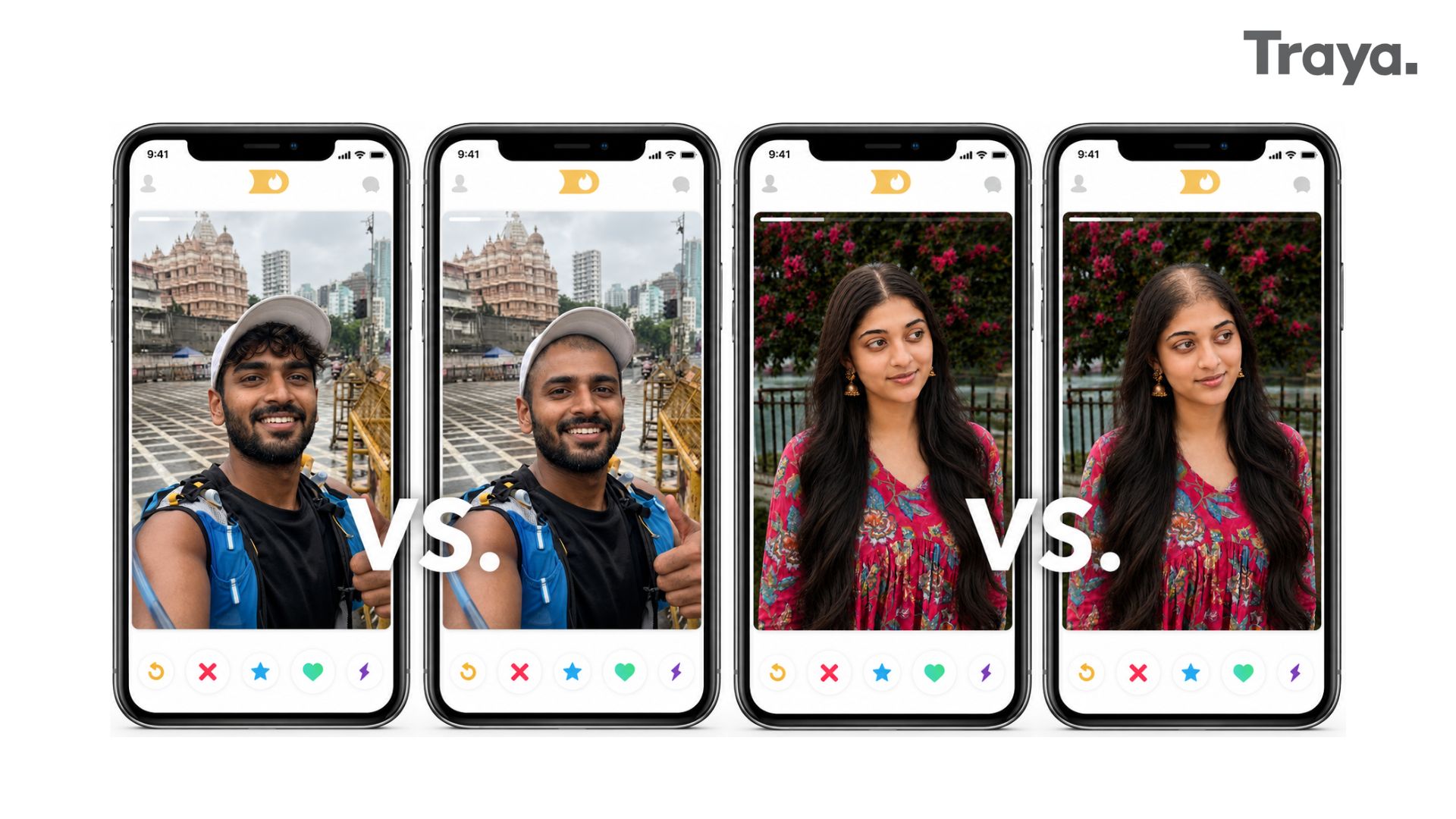
To isolate the role of hair, Traya created identical dating profiles using AI-generated images with the same base image, the same bio, and the same prompts with only one variable changed. One version showed fuller, healthier-looking hair; the other showed visible hair loss. AI-generated images were used to protect the privacy and consent of real individuals while allowing hair to be tested as the only variable.
The difference in engagement was striking.
For the male profile, the fuller-hair version received 28 likes compared with 0 for the hair-loss version.
For the female profile, the fuller-hair version received approximately 2,300 likes compared with 50 for the hair-loss version.
Profiles featuring healthier-looking hair received significantly higher engagement than profiles showing visible hair loss. In an age when people increasingly seek meaningful connection, why does hair play such a decisive role in how we respond to a potential partner? Is it simply a matter of appearance and judgement, or is something deeper at play?
Research has explored the relationship between hair and perceptions of age, health, and attractiveness. A 2025 study that systematically examined changes in hair characteristics found that these changes influence perceptions across all these dimensions, confirming that hair is an important visual cue in how we perceive another person.
People are not simply responding to hair as an aesthetic feature but to the different cues hair conveys, including perceptions of age and vitality.
Dr Rashi Soni, MBBS, a Consultant at Traya, says,
“Our response to hair is not limited to whether we consider it aesthetically pleasing. Hair contributes to the way we perceive a person’s age, attractiveness, and overall appearance, often as part of an immediate visual impression. This explains why changes in hair influence how someone is perceived, even before any meaningful interaction takes place.”
The striking difference observed in the experiment opens up a broader exploration into the deeper biological and evolutionary associations we attach to hair, often before conscious thought comes into play.
What Does Science Tell Us About Hair and Health?
Hair is often thought of primarily in terms of appearance. But beyond how it looks, hair can also reflect certain physiological states and provide information about aspects of what is happening within the body.
Researchers at Johns Hopkins School of Medicine, among others, have examined the potential of hair analysis as a diagnostic and biomarker tool, particularly through the information contained within the hair shaft and its chemical composition.
This is also why hair loss can be worth paying attention to. Hair loss can have multiple causes, ranging from genetic and hormonal factors to nutritional and metabolic influences. Androgenetic alopecia, the most common form of patterned hair loss, is closely associated with genetic predisposition and the sensitivity of hair follicles to androgens such as dihydrotestosterone.
Research has also explored the relationship between certain nutritional factors and hair loss. A 2024 systematic review examining micronutrients and androgenetic alopecia found associations between hair loss and nutrients, including vitamin D, iron and zinc. Other research has examined the relationship between hair loss and a range of nutritional, hormonal and haematological markers.
Taken together, this research points to an important idea: hair can be more than an aesthetic feature. It can be one of the visible cues through which aspects of our health and vitality are reflected, making hair loss something worth understanding, rather than simply something to conceal.
Could Evolution Play a Role?
Why Does Hair Influence Attraction? An Evolutionary Perspective
Why does a person making a judgement in under a second respond to hair so decisively? The answer is not vanity. It is biology.
In It’s Not You, It’s Biology, Joe Quirk argues that the physical traits we find attractive in a partner are not cultural accidents, media-driven trends, or shallow preferences. They are the direct output of natural selection biological programming shaped over millions of years that compels us toward traits signalling health, vitality, and fitness. We do not consciously choose these preferences. They were selected for us long before conscious choice existed.
Geoffrey Miller builds the scientific architecture for this in The Mating Mind, one of the most cited works in evolutionary psychology. His fitness indicator theory holds that traits become attractive because they are honest signals: difficult to fake, easy to read, and directly tied to biological quality. His classic illustration is the peacock’s tail, a display so metabolically expensive that only a genuinely healthy bird can sustain it. Hair functions the same way. It grows slowly, accumulates months of internal health data, and cannot be manufactured over time.
When hair is present and healthy, it signals a body that is nourished, balanced, and well. When it is absent, the brain registers a different signal – not a judgement of character or worth, but a biological flag it was built to notice before conscious thought can intervene.
The judgement happens before the thought.
Traya’s Perspective: Look Beyond the Mirror
At Traya, we have always believed that hair loss is about more than appearance. It can affect how we see ourselves, how others perceive us, and how we think about our own health and wellbeing.
Hair loss should not be a source of anxiety about how others perceive us. It is an opportunity to understand what may be contributing to it, whether genetic, hormonal, nutritional, or related to other factors, and to take action early.
Because hair is more than just a part of how we look. It is a part of how we experience ourselves and, sometimes, a reason to look a little deeper.