

Mr. Bhat began by reflecting on the universal human desire to improve lives – our own and those of others. He invoked the concept of creative destruction, not as a cold economic principle, but as a necessary act of renewal for society. “We must destroy old assumptions about money-making,” he urged, “and replace them with value creation.” For him, this was not a capitalist’s creed but a call to reimagine purpose in service.
Drawing parallels between Tata Trust and Rotary, Mr. Bhat offered a compelling comparison. The Tata Trust, he explained, was designed by the visionary Jamshedji Tata to give back to society many times over. Today, 66% of Tata Sons’ shares are owned by the Trust, ensuring that dividends from Tata Group companies flow back into philanthropic initiatives. This structure, he said, was “magical in its design and humbling in its impact.” Rotary, in his view, mirrored this ethos with its disciplined execution, strong governance, and culture of service. Both institutions, he noted, thrive on accountability and the ability to deliver tangible results on the ground.
Yet Mr. Bhat did not shy away from hard truths. He pointed to India’s per capita spend of $228, far below nations like China, Vietnam, Bangladesh, and Malaysia. This gap, he argued, is where Rotary can play a vital role – by channelling resources purposefully and creating lasting impact. He reminded the audience that India has “democratised aspiration,” with millennials demanding purposeful corporate action. Young people, he said, are no longer content with token gestures; they want to see governance, culture, and CSR initiatives that truly matter. Rotary, with its sharp focus and credibility, is well-positioned to meet this challenge.
His appeal was clear: Rotary must embrace creative destruction, shed outdated notions, and sharpen its impact. “Purpose is perpetual,” he declared, “and Rotary has the ability to be purposeful, sharper, and impactful in creating governance structures that endure.”
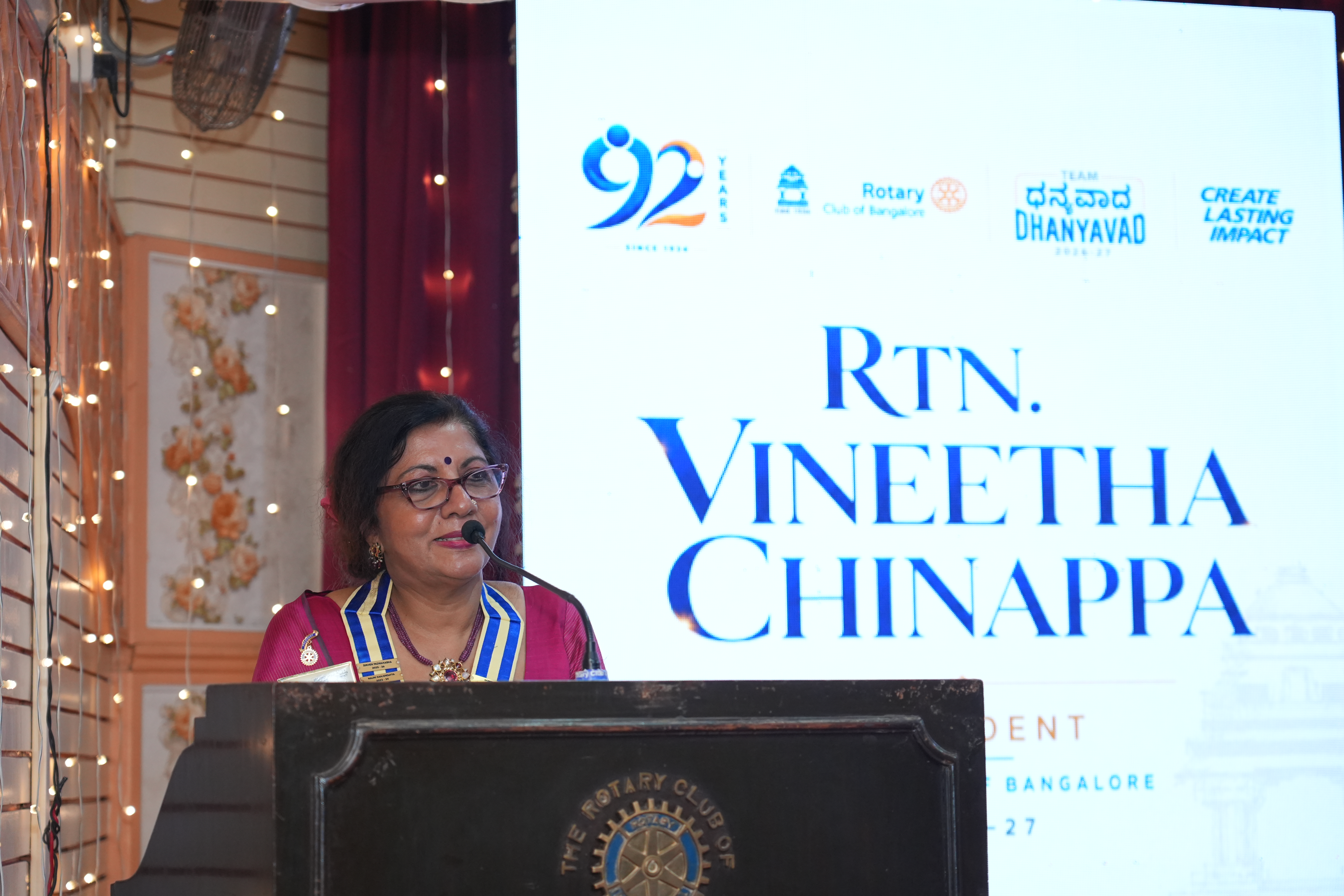
The evening also marked a new chapter for Rotary Bangalore, as Rtn Vineetha Chinappa was installed as the new President alongside the Secretary and a full-fledged Board for the year 2026-27. In her acceptance speech, Vineetha struck a tone of warmth and resolve. “Vision, commitment, and service – Dhanyaavad – gratitude is the essence of Rotary,” she said. For her, gratitude was not about nostalgia but about carrying forward a legacy with responsibility.
Her priorities for the year were clear: environment, lakes, and water conservation. “Restore, conserve, and educate,” she emphasised, “bringing people together for common purpose is the key function of RCB.” She dismissed the idea of chasing numbers, instead pledging to revive long-standing projects with compassion and action. Diversity of causes, she noted, is Rotary’s strength, and she set an ambitious target of Rs 10 crore worth of projects to make the year impactful. Her words carried both humility and determination, promising continuity with innovation.
The installation ceremony was presided over by District Governor Mr. A.K.S. Ravishankar Dakoju, who inducted the new Board for 2026–27. Six new members were also welcomed into the fold, adding fresh energy to the club’s ranks. Immediate Past President Mr. Sukheen Padmanabha and Secretary Kavitha Muthappa signed off their duties with trademark smiles, embodying the spirit of cheerful service that Rotary is known for.
The evening thus became more than a ceremonial transition; it was a dialogue between tradition and transformation. Mr. Bhat’s call for creative destruction resonated with Rotary’s ethos of purposeful service, while Vineetha’s vision for conservation and continuity grounded the club’s mission in practical action. Together, they sketched a roadmap where governance meets gratitude, and where service is not just an act but a philosophy.
As the gathering dispersed, one could sense that Rotary Bangalore stood at a threshold. The new Board carried the weight of legacy and the promise of renewal. With creative destruction as its guiding star and gratitude as its compass, the club seemed poised to sharpen its impact, deepen its purpose, and continue its journey of serving society – many times over.