
Kochi, Jan 30: The 7th edition of Mathrubhumi International Festival of Letters honoured the Father of the Nation, Mahatma Gandhi, by conducting a few special programs.
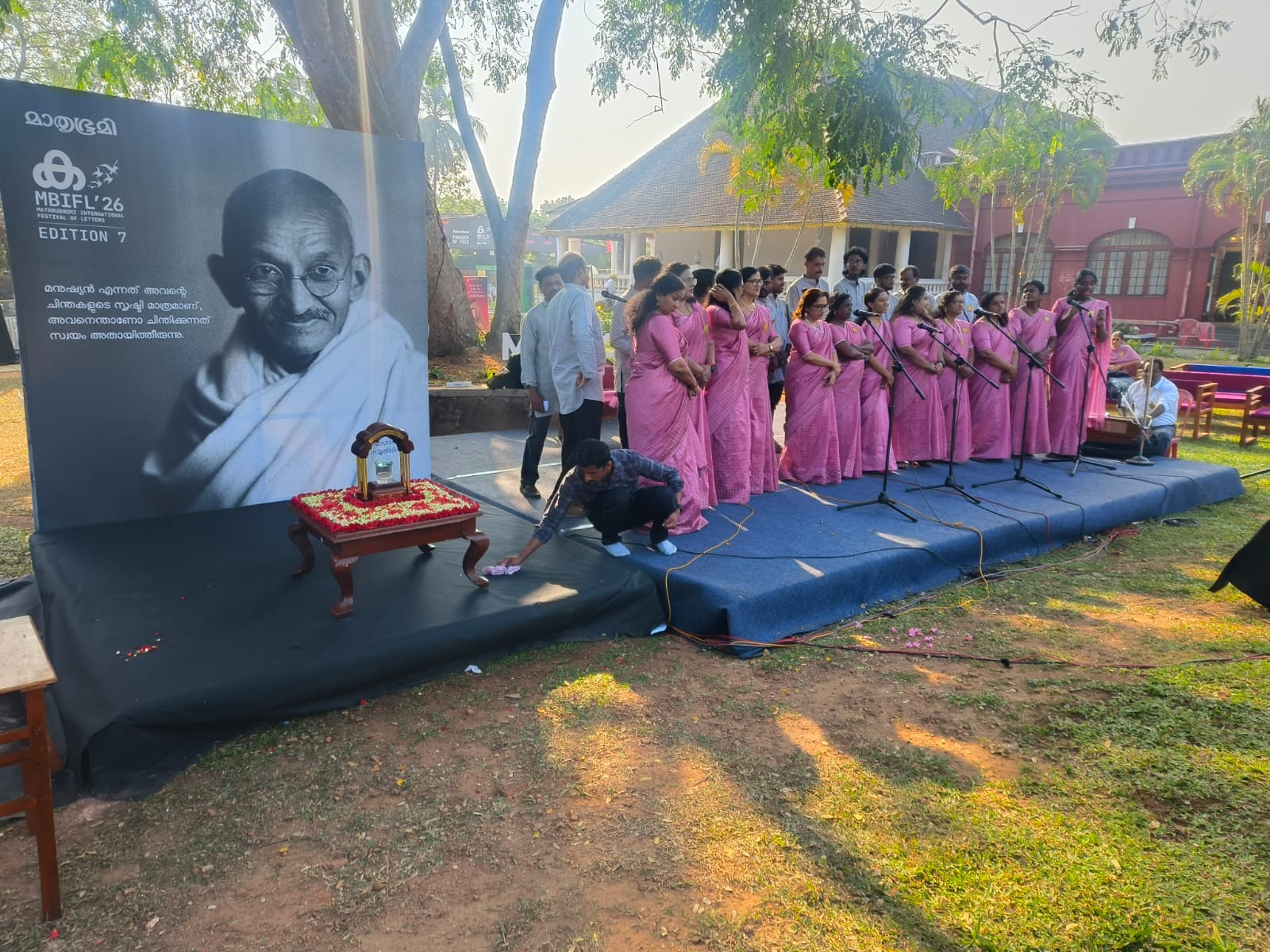
The opening day commenced with a bhajan sung by the MBS Choir group, along with a poem recited by acclaimed poet V Madhusoodanan Nair. A Pushpanjali was also facilitated at the blood-stained soil of Gandhiji, assembled at the meadow for the Gandhi smrithi at the festival venue.
A few special sessions were also lined up during day 2 of the festival, which included a session by Malayalam writers M N Karassery, P N Gopikrishnan, and Sunil P Illayidom titled “In Remembrance of Gandhi. A session on “Echoes of Truth: Why Gandhi matters more than Ever” by his great-grandson, Tushar Gandhi, was also part of this program.
Day 2 Session Highlights included a session on Conflicting paradigms: seeking new direction moderated by K George, resident editor at The Hindu with MP Priyanka Chaturvedi. The discussion focused on religion, identity, democracy and the shrinking space for coexistence in public life. MP Priyanka Chaturvedi spoke at length about how interaction across faiths has become fraught with suspicion. Sharing her own personal experiences, she described how exposure to diversity shaped her understanding of inclusion. Both speakers said rising suspicion around interfaith interaction reflects growing insecurity rather than any genuine danger to belief systems. They flagged fear-driven narratives around religion as a serious challenge to India’s plural and democratic values.
The session ‘The Wordy Pendulum; Oscillating between texts’ explored translation as one of the most intimate forms of reading. Harish Trivedi, who translated ‘Premchand: His Life and Times’ alongside Vanamala Viswanatha, who translated Kuvempu’s work in the title ‘Bride in the Hills’, writer Moutushi Mukherjee, as its moderator, discussed revisiting a long-standing question in translation studies: Does a translator know the text better than the author? Trivedi reflected on translating the biography of Premchand, while Vanamala spoke about translating the works of Kuvempu into English. Trivedi described translation as a “miraculous activity”—a movement from the unknown to the known, from darkness to light. Despite inevitable losses, the translator often gains a book that stands at a height far beyond those losses.
The session titled by Mumbai’s most wanted: the man who caught Charles Sobhraj’ was moderated by senior journalist Saraswathy Nagarajan and focused on crime, conscience and communal harmony, with legendary Mumbai Police officer ACP Madhukar Zende who revisited his extraordinary police career of 37 years catching the notorious criminal Charles Sobhraj the notorious criminal Charles Sobhraj, which was just a part of his career, not his proudest moment,” Zende said. He recalled first arresting Sobhraj in November 1971, when the criminal was still operating as a fraudster and car thief rather than the international serial killer he later became. The session also highlighted how ethical policing, courage during communal crises, and public trust shaped Mumbai’s response to one of its most volatile periods, offering timely lessons amid ongoing debates on law, order and social cohesion.
The other major highlights of the second day included Tharoor Sabha by the MP Shashi Tharoor, Actor Prakash Raj, writer Sangeeta Pillai, poet and rapper Oman bin Musa, and politician Raghav Chadha etc.
The festival concluded with a musical Live performance by Naresh Iyer with Vijay Ganeshan Band, featuring Srikant Hariharan and Aparna Harikumar.