

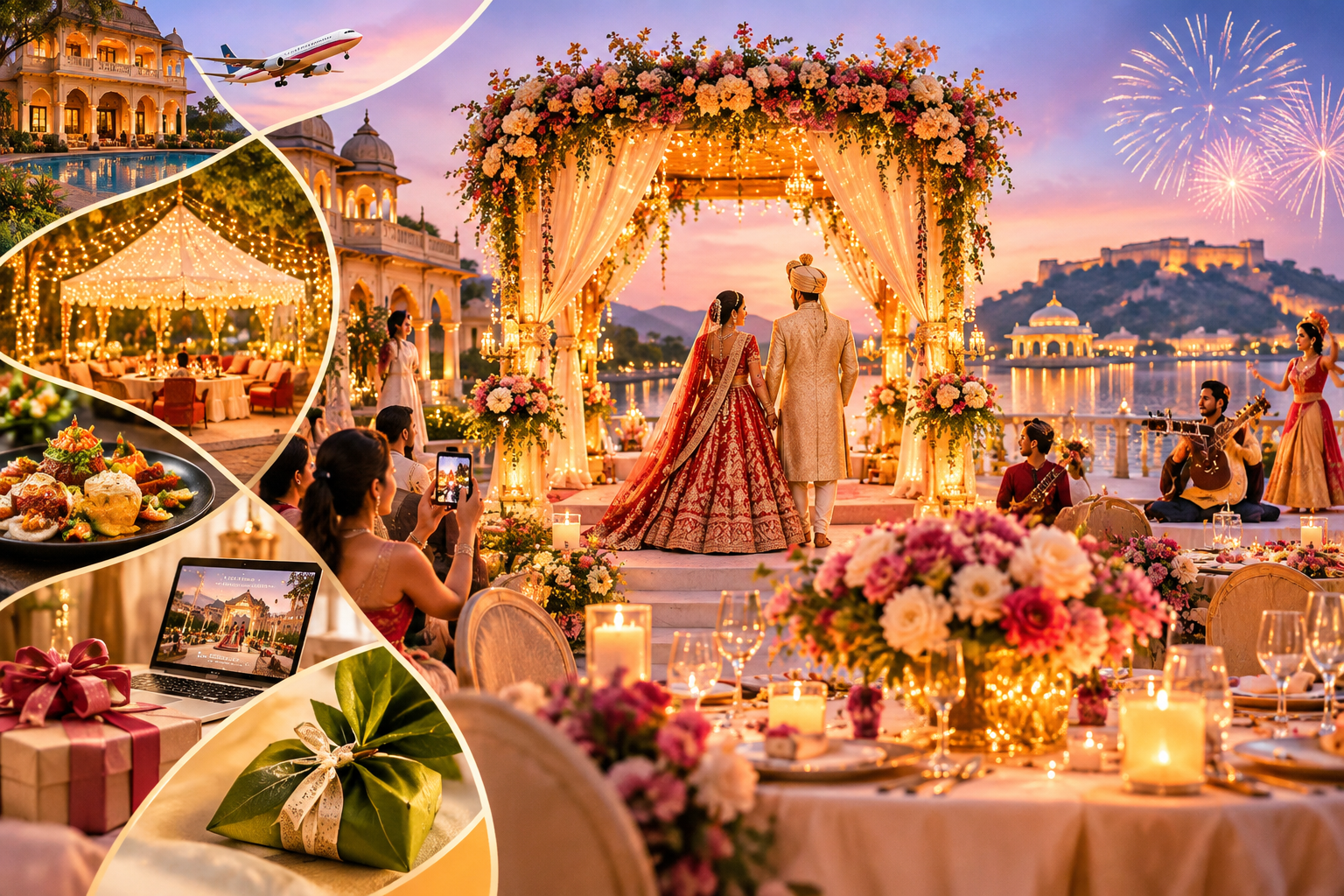
Nov 24: India’s wedding industry is undergoing a significant transformation, evolving from a largely tradition-driven expenditure market into an experience-led celebration economy. Weddings have always held immense cultural, emotional and social importance in Indian society. However, changing consumer preferences, rising disposable incomes, destination celebrations, personalised ceremonies and the growing influence of social media are redefining how Indian families plan and spend on weddings.
Today, a wedding is no longer viewed simply as a collection of rituals followed by a reception. It is increasingly designed as a multi-day experience, where hospitality, entertainment, food, décor, travel, wellness, photography and guest engagement contribute to the overall celebration. This shift is creating new opportunities across hospitality, tourism, event management, luxury services and the broader wedding ecosystem.
The changing nature of wedding expenditure also reflects a wider evolution in Indian consumption patterns. Families are increasingly willing to spend on memorable experiences, personalised services and distinctive celebrations rather than concentrating their budgets exclusively on conventional wedding essentials.
The Expanding Economic Scale of India’s Wedding Industry
The scale of India’s wedding economy demonstrates why it has become an important contributor to domestic consumption and service-sector growth.
According to the Confederation of All India Traders (CAIT), India’s first major wedding season of 2026, from 21 November to 15 December, is expected to generate approximately ₹7.5 lakh crore in wedding-related business through an estimated 52 lakh weddings. This represents a projected increase of 15.4% over the comparable 2025 wedding season.
An important aspect of this projection is the growing contribution of services. CAIT estimates that services will account for ₹3.45 lakh crore, or 46% of the projected business, while goods and retail purchases will contribute ₹4.05 lakh crore. Catering, venues, hotels, event management and wedding-related services form a substantial part of this expenditure.
This distribution highlights an important structural development: India’s wedding economy is no longer driven exclusively by jewellery, apparel and traditional purchases. Hospitality, curated celebrations, entertainment, travel and specialised event services are becoming increasingly important components of wedding budgets.
The wider economic impact is also significant. A wedding generates demand across several interconnected sectors, including accommodation, transportation, food services, floriculture, photography, lighting, production, beauty services and local tourism. Consequently, wedding spending creates economic opportunities beyond the immediate celebration.
The Shift Towards Experience-Led Wedding Spending
One of the most noticeable developments in the Indian wedding market is the growing preference for experiences that create lasting emotional and social value.
Traditionally, wedding budgets were concentrated on ceremonial clothing, jewellery, venue arrangements, food and customary rituals. These elements remain important, but contemporary couples and families are increasingly investing in how the wedding feels, how guests participate and what makes the celebration distinctive.
Experience-led spending involves designing celebrations around a cohesive theme, personal preferences and guest engagement. It can include destination ceremonies, welcome dinners, curated entertainment, interactive food experiences, personalised gifting, wellness arrangements and thoughtfully designed hospitality.
This transformation is particularly visible in the growing popularity of multi-day wedding celebrations. Instead of treating each function as an independent event, families are increasingly planning a connected sequence of experiences, from guest arrivals and welcome celebrations to the wedding ceremony and farewell gatherings.
The objective is to create a consistent experience in which every occasion has its own identity while contributing to the overall wedding narrative.
Destination Weddings and the Rise of Wedding Tourism
Destination weddings have become one of the strongest expressions of experience-led spending in India. They combine wedding celebrations with travel, accommodation, leisure and hospitality, creating a wider economic ecosystem around the event.
According to the 2025 annual wedding survey published by WedMeGood, approximately one in four surveyed weddings was a destination wedding, with nearly 90% of these celebrations taking place within India. The report also found that the average destination wedding budget was approximately ₹58 lakh, compared with ₹39.5 lakh for weddings overall.
Destination weddings had an average guest count of approximately 280, compared with 420 for local weddings. These findings indicate that a smaller guest list does not necessarily mean lower expenditure. Instead, families may allocate more resources towards accommodation, venue quality, guest activities and personalised services.
Indian destinations such as Rajasthan, Goa, Kerala, Uttarakhand and other scenic locations are benefiting from this trend. Heritage properties, beach resorts, hill destinations and private hospitality venues are increasingly being considered for wedding celebrations.
The impact extends beyond wedding venues. Destination celebrations generate business for hotels, restaurants, transport operators, local guides, decorators, entertainers and other tourism-related service providers.
Wedding tourism is therefore emerging as an important opportunity for destinations seeking to attract high-value domestic visitors.
Personalisation as a Key Driver of Wedding Budgets
Personalisation has become an important factor influencing wedding expenditure. Couples increasingly want their celebrations to reflect their individual personalities, cultural backgrounds, shared interests and personal journeys.
This has expanded the scope of wedding planning beyond conventional arrangements. Customised invitations, personalised welcome hampers, themed ceremonies, bespoke décor, curated music, storytelling through photography and specially designed guest activities are becoming part of the wedding experience.
The 2025 wedding industry survey indicates that the average wedding budget increased by 8% year-on-year to ₹39.5 lakh. It also reports that destination weddings command a higher average budget of ₹58 lakh. These figures suggest that families are increasingly allocating substantial budgets to celebrations that offer greater personalisation and differentiated experiences.
Personalisation is also influencing food and beverage arrangements. Rather than relying exclusively on large traditional buffets, some weddings are incorporating regional food concepts, live culinary stations, chef-led menus, themed dining and interactive food presentations.
The emphasis is gradually shifting from simply providing hospitality to creating memorable hospitality.
Hospitality and Guest Experience Become Central
The growing importance of guest experience is changing the role of hospitality in wedding planning.
Earlier, accommodation and transportation were often treated as supporting arrangements. Today, they are increasingly considered essential parts of the celebration itself.
Families are paying greater attention to guest arrival experiences, room arrangements, welcome services, local sightseeing, transportation coordination, leisure activities and personalised assistance.
This trend is particularly relevant for destination weddings, where guests may travel considerable distances and spend multiple days at the celebration.
A report published by KPMG in India in August 2026, examining the wider events and experiences economy, provides useful evidence of this development. Its primary survey found that 54.4% of visitors travelled outside their city of residence to attend their most recent event. Outstation visitors accounted for 70.4% of total scaled visitor spending, reflecting the importance of travel, accommodation and related services in event economics.
The report also found that 51.5% of respondents travelled specifically to attend the event. Although these findings cover the broader events industry rather than weddings alone, they demonstrate the economic significance of experience-led travel and hospitality.
For the wedding industry, this creates opportunities to develop more comprehensive guest experiences that combine accommodation, dining, entertainment, local culture and leisure.
Entertainment, Décor and Immersive Celebrations
Wedding entertainment and visual presentation are also undergoing a transformation.
Music and dance performances remain integral to Indian weddings, but their formats are evolving. Live performances, interactive entertainment, curated musical programmes, themed celebrations and immersive installations are increasingly being incorporated into wedding schedules.
Décor has similarly moved beyond conventional floral arrangements and stage designs. Families are showing interest in venue transformations, lighting concepts, thematic installations, personalised backdrops and visual storytelling.
The growing influence of digital content and social media has further strengthened this trend. Wedding celebrations are increasingly planned with attention to photography, videography and the visual identity of each function.
However, the significance of these investments extends beyond photographs. A well-designed environment can influence how guests interact with the venue, participate in activities and remember the celebration.
This has increased demand for specialised professionals working across creative direction, production, lighting, floral design, entertainment and visual documentation.
Technology and the Changing Wedding Planning Process
Technology is becoming an important part of the modern wedding ecosystem.
Digital invitations, online guest management, event scheduling, accommodation coordination, personalised communication and digital payment systems are making wedding planning more organised.
The 2025 wedding industry survey found that 38% of surveyed couples made most of their wedding payments digitally. It also reported that 24% of wedding professionals were using artificial intelligence tools for activities such as editing, design, content preparation and automated responses.
These developments indicate that technology is gradually influencing both the planning process and the delivery of wedding experiences.
Artificial intelligence can assist with creative concepts, visual previews, guest communication and administrative coordination. Digital systems can also help manage complex schedules involving multiple venues, vendors and guest groups.
As weddings become more elaborate, efficient coordination and technology-enabled planning are likely to become increasingly important.
Sustainability and Responsible Wedding Experiences
Another emerging consideration is the balance between luxury, personalisation and environmental responsibility.
Large celebrations can generate considerable waste through food consumption, disposable materials, floral arrangements, packaging and transportation. As awareness of environmental issues grows, some families and event professionals are exploring more responsible approaches to wedding planning.
These include locally sourced food, reusable décor structures, responsible floral disposal, reduced plastic usage, digital invitations and better food-waste management.
KPMG’s 2026 events and experiences study found that 70% of surveyed visitors were willing to pay a 5–10% premium for environmentally sustainable events. The finding relates to the wider events sector, not exclusively weddings, but indicates growing consumer interest in sustainability as part of the experience.
For the wedding industry, sustainability can become an important component of premium hospitality rather than simply a cost-saving measure.
Employment Generation and Opportunities Across the Wedding Ecosystem
The growth of experience-led wedding spending is also expanding employment opportunities.
Modern weddings require coordinated contributions from a diverse range of professionals, including event planners, hospitality teams, caterers, photographers, makeup artists, musicians, choreographers, florists, designers, transportation providers, technicians and logistics personnel.
According to CAIT’s projections reported in November 2026, the current major wedding season could generate approximately 1.25 crore temporary, seasonal and part-time employment opportunities across India. These are projected opportunities rather than verified employment outcomes.
The expansion of destination celebrations is particularly significant for smaller cities and tourism destinations. Local accommodation providers, restaurants, transport operators, artisans and cultural performers can benefit from wedding-related demand.
This also creates opportunities for Tier-2 and Tier-3 cities to develop their hospitality infrastructure and attract high-value event tourism.
The Emergence of Micro-Luxury Weddings
An interesting development within India’s wedding economy is the emergence of smaller but more carefully curated celebrations.
Rather than prioritising the largest possible guest list, some couples are choosing more intimate gatherings where greater attention can be given to individual guests, hospitality, dining and personalised activities.
This approach is often described as micro-luxury.
The concept does not necessarily mean spending less. A smaller celebration can have a relatively high per-guest expenditure because families may invest more in accommodation, premium dining, customised experiences and detailed event execution.
The 2026 wedding season coverage by Financial Express highlights this movement towards intimate celebrations, personalised food experiences and chef-led dining. Industry estimates cited in the report suggest that average city wedding budgets are around ₹30–50 lakh.
Micro-luxury reflects a broader change in consumer priorities: the perceived value of a wedding is increasingly connected to the quality of the experience rather than simply the number of attendees.
Challenges Facing the Experience-Led Wedding Industry
Despite its growth potential, the Indian wedding industry faces several challenges.
Rising hospitality costs, seasonal demand, limited venue availability and increasing expectations can create considerable pressure on wedding budgets. Destination celebrations also require complex logistical coordination, particularly when guests are travelling from different cities or countries.
The availability of skilled professionals remains another important concern. High-quality event execution requires trained teams, reliable suppliers, effective communication and strong operational management.
There are also financial considerations. The 2025 wedding industry survey found that 15.2% of surveyed couples used loans to finance their weddings, while 78.65% relied on savings. The average reported wedding loan was ₹15.5 lakh. These findings underline the importance of financial planning as wedding aspirations and expenditure increase.
For the industry to grow sustainably, experience-led celebrations must balance creativity and quality with financial discipline, transparent pricing, operational efficiency and responsible resource management.
The Future of India’s Wedding Industry
The future of India’s wedding industry is likely to be shaped by the convergence of personalisation, hospitality, tourism, technology and experiential consumption.
The traditional elements of Indian weddings will continue to hold cultural importance. However, the way celebrations are designed, delivered and experienced will continue to evolve.
Destination weddings, intimate luxury celebrations, personalised entertainment, immersive décor, curated dining and guest-focused hospitality are likely to remain important areas of opportunity.
The broader events industry is also receiving increasing attention as a contributor to tourism and economic development. KPMG’s 2026 study estimates that every ₹1 of direct event-related expenditure is associated with approximately ₹1.46–₹2.03 of total economic activity across the four event categories it assessed. This multiplier should not be interpreted as a wedding-specific estimate, but it illustrates the wider economic potential of experience-led activities.
For wedding professionals, the opportunity lies in moving beyond the conventional role of arranging ceremonies and developing integrated experiences that combine creativity, hospitality, technology and operational excellence.
For hospitality businesses and tourism destinations, weddings can become an important source of high-value demand, supporting accommodation, food services, transportation and local economic activity.
Ultimately, India’s wedding industry is moving towards a model in which the celebration itself becomes a carefully designed experience. The value of a wedding is no longer measured only through its scale, grandeur or expenditure, but increasingly through the memories it creates, the quality of hospitality it delivers and the emotional connection it establishes with its guests.
Experience is becoming one of the most important currencies of India’s evolving wedding economy.