

Kharagpur, Nov 21: Prime Minister Narendra Modi on Saturday urged students and alumni of IIT Kharagpur to challenge conventional thinking, pursue ambitious goals and contribute to India’s transformation into a developed nation by 2047.
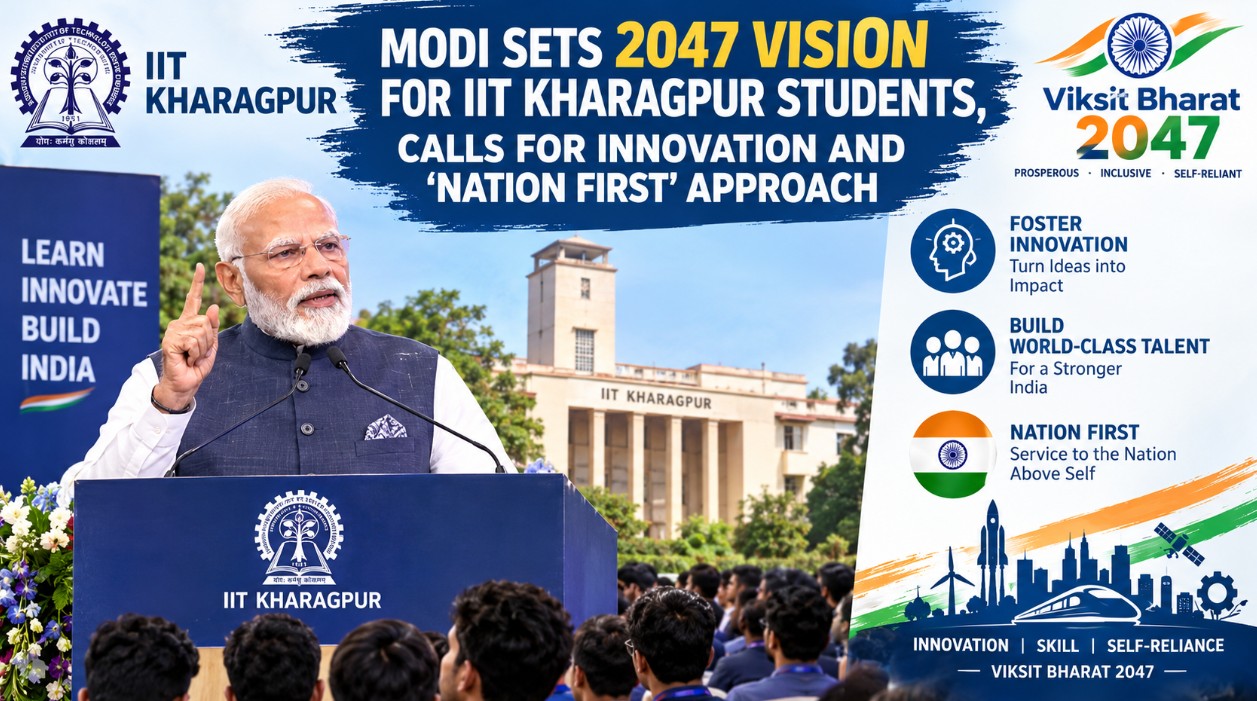
Representational Image
Addressing the institute’s Platinum Jubilee celebrations, Modi said the country’s progress depended on its ability to overcome self-imposed limitations and turn seemingly impossible goals into achievable realities.
He described IIT Kharagpur’s 75-year journey as closely connected with India’s own development, pointing out that the country’s first Indian Institute of Technology had contributed to nation-building through successive phases of industrialisation, scientific research, space technology and the information technology revolution.
The Prime Minister also called on the institute’s students and alumni to use their knowledge and innovation to address major national challenges, saying their professional achievements should contribute to the larger goal of building a developed India.
From a Detention Camp to a Centre of Innovation
Recalling the history of the institution, Modi highlighted the significance of its location, which once housed a detention camp for freedom fighters during the British rule.
He said the same land that had witnessed the struggle for self-rule was now nurturing young minds working towards India’s self-reliance.
“Then, the dream was freedom; today, the opportunity is to build the future,” was the central message of his remarks on the institution’s historical transformation.
The Prime Minister said the aspirations of freedom fighters had helped shape the country’s journey, while the ideas and innovations of present-day students could strengthen India’s ambition of becoming self-reliant.
He also congratulated the faculty, staff, students and alumni for the institute’s contribution over the past 75 years.
IIT Kharagpur’s Role in India’s Changing Economy
Modi recalled that IIT Kharagpur began its journey shortly after Independence, when India urgently needed engineers to build its industries and infrastructure.
As the country expanded its scientific capabilities, graduates from the institution contributed to areas such as space research and atomic energy. Later, during the rise of information technology and the expansion of the global economy, its alumni played an important role in strengthening India’s software industry and taking leadership positions in major global companies.
He said the institution must now prepare to play an equally significant role in the next phase of India’s development, particularly as the country focuses on innovation, advanced manufacturing and emerging technologies.
‘Break the Limits’: Modi on Changing India’s Mindset
A major theme of the Prime Minister’s address was the need to overcome what he described as “limiting beliefs” — the tendency to restrict ambitions by assuming that certain goals are beyond reach.
He said individuals and nations often limit their potential by deciding in advance what is possible and what is not.
Citing poverty reduction as an example, Modi said India had moved beyond the belief that poverty was an unavoidable and permanent challenge.
He referred to government initiatives aimed at improving access to sanitation and essential services, saying the focus had shifted towards empowering people and improving their quality of life.
The Prime Minister also cited a recent World Bank report, which he said showed that around 50 crore people in India had moved out of poverty over a period of 12-13 years. The figure was presented as an example of what could be achieved through a change in policy priorities and national ambition.
Semiconductor Mission: India Looks Beyond Late Entry
Modi also highlighted the country’s efforts to build a domestic semiconductor ecosystem, recalling that the decision to launch the semiconductor mission had initially faced questions over India’s ability to compete in an industry dominated by established global players.
He referred to an earlier attempt by a foreign company to set up semiconductor manufacturing operations in India decades ago, which did not materialise.
The Prime Minister said India could not continue to remain on the sidelines simply because other countries had entered the sector earlier.
He pointed to the development of semiconductor facilities in recent years and India’s entry into chip exports as signs of progress.
Encouraging IIT Kharagpur students to take advantage of the emerging opportunities, he said the country’s ambitions extended across the entire manufacturing and technology ecosystem — from chips to ships.
Space Sector Opening New Doors for Start-ups
The Prime Minister cited the opening up of India’s space sector to private participation as another example of breaking conventional barriers.
He said young innovators outside the traditional space establishment had earlier faced limited opportunities to participate in the country’s space programme. Policy changes, he added, had created greater scope for private companies and start-ups to contribute to space technology and launch services.
Highlighting the contribution of IIT Kharagpur alumni, Modi referred to Pawan Kumar Chandana, co-founder of Skyroot Aerospace, whose company developed India’s first privately built rocket to reach space.
He said the growing number of space start-ups was giving fresh momentum to India’s space programme and demonstrating how young innovators could turn ambitious ideas into practical achievements.
‘Nation First’ Should Guide Young Professionals
Looking ahead, Modi said the coming two decades would be among the most productive and decisive years for the current generation of students.
By 2047, many of them would be occupying leadership positions across industries, research institutions and public life, making their contribution important to India’s development journey.
He urged students to identify the challenges facing the country and consider how their skills could help solve them.
“Nation First,” he said, should remain the guiding principle for young professionals and innovators. He added that a commitment to national priorities could also create new opportunities for individual growth.
A Developed India by IIT Kharagpur’s Centenary
Concluding his address, the Prime Minister set an ambitious goal for the institute: its centenary celebrations should take place in a developed India.
He recalled that freedom fighters held firm to their resolve to secure Independence while confined at the detention camp that once stood on the campus site. Drawing a parallel, he called on the present generation to commit itself to building a developed India within the next two decades.
Quoting Swami Vivekananda, Modi ended his address with the message: “Arise, awake, and stop not until the goal is reached.”
As IIT Kharagpur marks 75 years of academic and technological contributions, the Prime Minister’s message placed the institution’s next chapter within the larger national ambition of innovation, self-reliance and development by 2047.