

India’s digital economy is entering a new phase of transformation, driven by rapid technological development, increasing internet adoption and the growing demand for faster, more reliable connectivity. From online banking and e-commerce to artificial intelligence, smart manufacturing and digital healthcare, connectivity has become a critical foundation for modern businesses. As 5G networks expand across the country, attention is gradually shifting towards the next generation of wireless communication 6G.
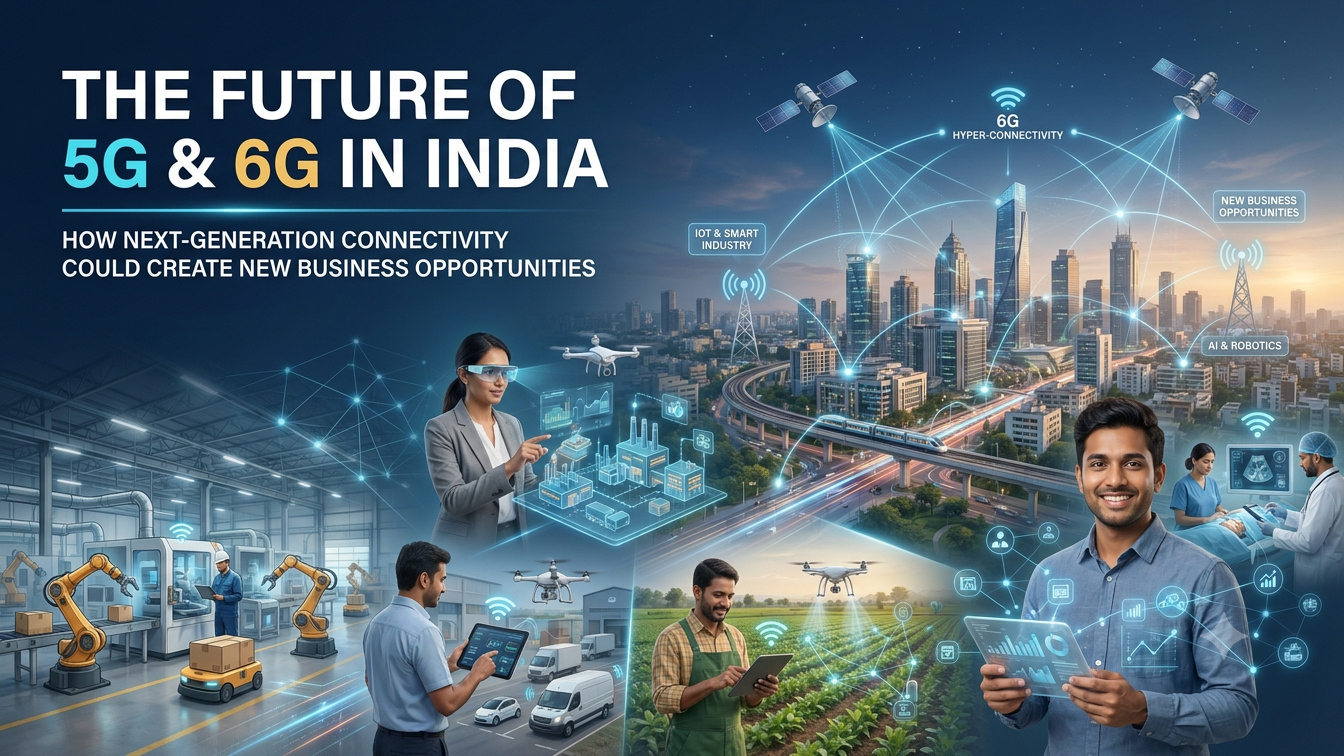
The evolution from 5G to 6G is expected to create opportunities that extend far beyond faster internet speeds. It could transform how businesses operate, how industries manage resources, how customers access services and how entrepreneurs develop new technology-driven solutions.
For India, this transition represents an opportunity not only to improve digital infrastructure but also to strengthen its position in the global technology and telecommunications industry.
India’s Growing 5G Ecosystem: Building the Foundation for the Future
The introduction of 5G has significantly changed India’s telecommunications landscape. Higher data speeds, lower network latency and improved connectivity are creating possibilities for applications that require real-time communication and large amounts of data.
According to the Ministry of Communications, by February 2026, 5G services were available in 99.9% of India’s districts, supported by more than 5.23 lakh installed 5G base transceiver stations.
This expansion is creating opportunities for telecom operators, infrastructure providers, technology companies and startups. Businesses can use 5G-enabled solutions to improve operational efficiency, develop digital products and reach customers through new channels.
However, the real value of 5G will depend on how effectively industries convert improved connectivity into practical business applications.
How 5G Could Transform Business Opportunities Across Industries
1. Smart Manufacturing and Industrial Automation
Manufacturing is among the sectors that could benefit significantly from 5G technology. Reliable, low-latency connectivity can support connected machinery, industrial robotics, automated production lines and real-time equipment monitoring.
Factories can use connected sensors to identify equipment problems, monitor production performance and reduce unexpected downtime. These capabilities could help manufacturers improve productivity, manage operational costs and maintain product quality.
For Indian manufacturing businesses, particularly small and medium-sized enterprises, 5G-enabled industrial solutions could create opportunities to compete more effectively in domestic and international markets.
2. Healthcare and Remote Medical Services
The healthcare industry could also experience major changes through next-generation connectivity. 5G can support high-quality video consultations, remote patient monitoring, connected medical devices and faster exchange of medical information.
Hospitals and healthcare providers may use connected technologies to improve coordination between specialists and patients, particularly in locations where access to advanced medical facilities is limited.
For health-tech startups, this creates opportunities to develop remote monitoring platforms, connected diagnostic solutions and digital healthcare services.
3. Agriculture and Smart Farming
Agriculture remains an important part of India’s economy, and connectivity could help farmers make more informed decisions.
5G-enabled sensors, drones and smart farming platforms can support soil monitoring, weather analysis, irrigation management and crop-health assessment.
Agri-tech companies can develop solutions that help farmers use water efficiently, monitor crop conditions and improve agricultural productivity. These innovations could also encourage investment in precision agriculture and rural technology services.
4. E-commerce and Digital Customer Experiences
Faster and more reliable connectivity can improve online shopping experiences through high-quality product demonstrations, augmented reality, virtual experiences and interactive customer services.
Retailers could introduce virtual product trials, immersive shopping platforms and personalised digital experiences. Logistics companies may also benefit from connected tracking systems and real-time supply-chain monitoring.
This could create fresh opportunities for e-commerce platforms, digital marketing agencies, software developers and technology startups.
6G: The Next Major Opportunity for India’s Technology Industry
While 5G adoption is continuing, researchers and technology companies are already working towards 6G, the sixth generation of wireless communication.
Unlike a simple upgrade in internet speed, 6G is expected to introduce more intelligent, integrated and responsive communication networks. Emerging research areas include artificial intelligence-powered networks, advanced sensing technologies, satellite-based connectivity and improved integration between digital and physical environments.
India released its Bharat 6G Vision in March 2023, with the ambition of becoming a leading contributor to the design, development and deployment of 6G technology by 2030.
The government is also supporting research through the Bharat 6G Alliance, which brings together industry players, academic institutions, startups and research organisations.
According to a July 2026 government update, the Bharat 6G Alliance had expanded to 90 member organisations, reflecting growing collaboration across India’s telecom ecosystem.
Emerging Business Opportunities Through 6G Technology
The development of 6G could open new business opportunities across several technology-driven industries.
1. Artificial Intelligence and Intelligent Networks
Future 6G networks are expected to integrate artificial intelligence more deeply into network operations. AI could help manage network traffic, predict technical failures, improve connectivity and optimise resource utilisation.
This may create opportunities for AI developers, software companies, telecom equipment manufacturers and cybersecurity businesses.
2. Satellite and Rural Connectivity
One of the important possibilities of 6G is improved integration between terrestrial networks and non-terrestrial networks, including satellites and high-altitude platforms.
This could help extend digital connectivity to remote villages, agricultural regions, coastal areas and locations where conventional telecom infrastructure is difficult to establish.
Businesses could explore satellite communication services, rural broadband solutions and connected digital platforms.
3. Immersive Communication and Virtual Experiences
Future communication technologies may support advanced augmented reality, virtual reality and holographic communication experiences.
These developments could create opportunities in online education, entertainment, virtual shopping, tourism, professional training and remote collaboration.
4. Autonomous Systems and Smart Transportation
Advanced connectivity could improve communication between vehicles, road infrastructure and traffic management systems.
Automotive companies, mobility startups and logistics providers may benefit from technologies supporting intelligent transportation, connected vehicles and automated operations.
Why Startups and Small Businesses Should Pay Attention
The growth of next-generation connectivity will not benefit only large telecommunications companies. Startups, entrepreneurs and small businesses could also become important participants in the emerging digital ecosystem.
For example, technology startups could develop applications for smart agriculture, industrial monitoring, connected healthcare and AI-powered business services.
Small and medium-sized enterprises could use improved connectivity to modernise operations, automate routine activities and access wider markets.
Telecom infrastructure development may also create demand for specialised services, including network installation, cloud computing, cybersecurity, software development and technical maintenance.
For entrepreneurs, the opportunity lies in identifying practical problems that better connectivity can solve rather than simply developing technology without a clear business purpose.
India’s 6G Research and Indigenous Technology Push
India’s ambition to participate in the global 6G ecosystem is supported by research, innovation and collaboration between government, industry and academic institutions.
The Telecom Technology Development Fund is supporting research in areas such as 6G communication, quantum communication, telecom security and satellite networks.
A March 2026 government update reported that 136 research and development projects had been approved under the programme, including 104 projects related to 6G technology.
These initiatives could encourage domestic technology development, strengthen intellectual property creation and reduce dependence on imported telecommunications technologies.
For Indian startups and research institutions, this presents an opportunity to participate in developing future communication standards, equipment and applications.
Challenges That Could Influence the Growth of 5G and 6G
Despite the promising opportunities, the transition towards next-generation connectivity will involve several challenges.
High Infrastructure Investment: Expanding advanced telecom networks requires significant investment in spectrum, fibre-optic infrastructure, base stations and supporting technologies.
Digital Divide: Rural and remote communities may continue to face connectivity gaps if infrastructure development remains concentrated in economically stronger regions.
Cybersecurity and Data Privacy: Increasingly connected devices and intelligent networks could create additional security risks. Businesses will need stronger data protection and cybersecurity systems.
Affordable Technology: The cost of compatible devices, network services and digital infrastructure must remain manageable for consumers and smaller businesses.
Skilled Workforce: The telecom industry will require professionals with expertise in artificial intelligence, network engineering, cloud computing, cybersecurity and advanced communication systems.
Addressing these challenges will be essential to ensure that technological progress translates into sustainable economic development.
What the Future Holds for India’s Digital Economy
The future of India’s telecommunications industry will depend on how effectively the country combines infrastructure expansion with innovation, investment and practical business applications.
5G is expected to remain an important driver of digital transformation in the coming years, while 6G research is laying the foundation for the next stage of connectivity.
Businesses that invest in digital capabilities, develop technology partnerships and prepare their workforce for emerging communication technologies could gain a competitive advantage.
Government initiatives, private-sector participation, domestic manufacturing and research collaboration will also play important roles in building a stronger telecommunications ecosystem.
Conclusion: Turning Next-Generation Connectivity into Economic Growth
The evolution of 5G and 6G represents more than a technological advancement for India. It offers an opportunity to create new business models, strengthen industries, encourage entrepreneurship and expand access to digital services.
While 5G is opening new possibilities in manufacturing, healthcare, agriculture, retail and logistics, 6G could take connectivity further through intelligent networks, advanced sensing, satellite integration and immersive digital experiences.
India’s ambition to contribute to global 6G development by 2030 could create opportunities for technology companies, startups, investors and skilled professionals.
Ultimately, the success of next-generation connectivity will not be measured only by internet speed. Its real impact will depend on how effectively it improves businesses, creates employment, supports innovation and makes digital opportunities accessible to more people across the country.