

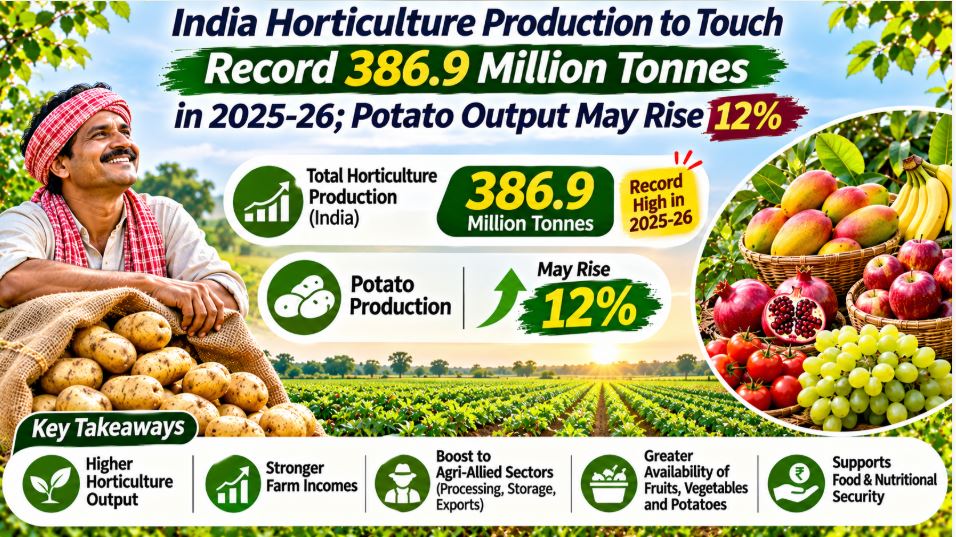
New Delhi, Nov 17: India’s horticulture sector is projected to achieve a record production of 386.9 million tonnes in 2025-26, registering a 4.36% increase over the previous year, even as the total area under cultivation is expected to decline.
Representational Image
The Third Advance Estimates, released by Union Agriculture and Farmers’ Welfare Minister Shivraj Singh Chouhan on Monday, put the country’s horticulture output at 3,869.15 lakh tonnes, up by 161.77 lakh tonnes from 3,707.38 lakh tonnes in 2024-25.
The estimated growth comes despite a reduction in the area under horticultural crops, from 301.36 lakh hectares to around 297.21 lakh hectares. The rise in output points to improved productivity and expanding cultivation of high-value crops, according to the government.
Chouhan said the projected record production would strengthen nutritional security and support farmers’ incomes. He also highlighted the growing shift towards commercial horticulture, with farmers diversifying into fruits, vegetables, flowers, spices, plantation crops and medicinal plants.
Fruit production crosses 123 million tonnes
Fruit production is estimated to reach 1,230.66 lakh tonnes in 2025-26, a growth of 4.60% over the previous year’s 1,176.49 lakh tonnes.
Higher output of banana, mango, papaya, apple, pomegranate and jackfruit is expected to drive the increase, adding an estimated 54.18 lakh tonnes to overall fruit production.
Vegetable output projected at 227.3 million tonnes
Vegetables remain the largest contributor to India’s horticulture output. Production is projected to rise 4.35% to 2,272.68 lakh tonnes, compared with 2,177.97 lakh tonnes in 2024-25.
The area under vegetable cultivation is also expected to expand from 117.91 lakh hectares to 119.31 lakh hectares.
Potato is likely to record one of the strongest gains, with production estimated at 655.70 lakh tonnes — an increase of nearly 12% over the previous year’s 585.71 lakh tonnes. Tomato output is projected to rise to 214.11 lakh tonnes from 205.99 lakh tonnes, while onion production is estimated at 288.96 lakh tonnes.
Brinjal, bottle gourd, cucumber, cabbage, beans and peas are among the other crops contributing to the projected growth.
Flower production records strong expansion
The floriculture segment is also expected to register significant growth. Flower production is projected to increase by 14.45%, reaching 48.82 lakh tonnes in 2025-26 against 42.65 lakh tonnes in the previous year.
The area under flower cultivation has risen to an estimated 4.10 lakh hectares, indicating growing interest in the sector.
Plantation crops and medicinal plants gain ground
Production of plantation crops, including arecanut, coconut, cashew, betel leaves and cocoa, is estimated to increase by 7.56% to 182.64 lakh tonnes.
The output of aromatic and medicinal plants is also projected to rise, from 9.01 lakh tonnes in 2024-25 to 9.28 lakh tonnes in 2025-26.
The expansion reflects the wider diversification of Indian agriculture towards crops that offer opportunities in food processing, value addition and specialised markets.
Spice production estimated at 123.5 lakh tonnes
India’s spice production is projected to reach 123.54 lakh tonnes in 2025-26, with the area under spice cultivation estimated at 47.56 lakh hectares.
Improved production of turmeric, garlic, curry leaves and cardamom is expected to support the sector’s performance, according to data from the Directorate of Arecanut and Spices Development.
The estimates have been prepared by the Department of Agriculture and Farmers’ Welfare using information received from states, Union Territories and other government agencies.
With output projected to rise across most major horticulture segments despite a smaller overall cultivated area, the latest estimates point to the growing importance of productivity, crop diversification and high-value farming in India’s agricultural economy.